Match Cigars to Your Palate: Research Cigars Online for Smokers

Research cigars online by matching strength and flavor to your own palate through a short, repeatable workflow, not by chasing the highest score on a review site. That means checking a cigar's strength category alongside its rating, pulling a few structured flavor notes, and comparing them against your own tasting history. We'll walk through the exact steps and give you a journal template you can use on your very next purchase.
TL;DR:
- Before buying, identify the exact cigar and size, then compare strength, flavor, construction, and price; ring gauge and length can alter the smoke.
- Trust reviews that explain their method, especially blind tasting; Cigar Aficionado has used it since 1992, and scores from different outlets are not directly comparable.
- A mild cigar rated 89 may suit you better than a stronger cigar rated 94, so compare strength and flavor before scores.
- Record expectations before smoking, then log strength, flavors for each third, draw, burn, finish, context, and whether you would buy it again.
- For unfamiliar sellers, verify retailer history, compare packaging with authentic examples, distrust unusually low prices, and check recent community reports before ordering multiples.
Step-by-step online research workflow to use before you buy or smoke
A good research pass takes ten minutes, and follows the same order every time. That consistency is what makes the results comparable from one cigar to the next.
- Identify the exact cigar and size. The same blend in a robusto and a toro can smoke differently because ring gauge and length change the burn rate and how the filler tobaccos combine.
- Gather at least one method-transparent review. Look for a publication that explains how it tastes cigars, plus a few community impressions from a forum or retailer page.
- Extract comparable fields. Pull out strength category, the two or three dominant flavor families, construction and draw notes, finish length, dimensions, and price.
- Filter by strength and flavor fit first. Only use the numeric score to break a tie between two cigars that already match what you like.
- Write down your pre-smoke expectation. A single sentence is enough: what you expect the cigar to taste like and how strong you expect it to hit.
A few habits make this workflow stick:
- Keep your notes in the same format every time, even if it's just a few bullet points.
- Treat the score as a tiebreaker, not a filter.
- Record the expectation before lighting up so you can check it against what you actually tasted.
This last step matters more than it sounds. Cigar Aficionado's tasting process recommends recording results before and after the smoke specifically because comparing expectation to outcome is what teaches you your own palate over time. Skip that step and every cigar you research starts to blur together.
How to read reviews and scores: credibility signals and how to weight them
A review is only as useful as its method. Before you trust a score, check whether the publication explains how it got there.
- Look for blind tasting. Cigar Aficionado has conducted blind tastings since 1992, buying cigars at retail and replacing the bands with numbered labels before judging construction, draw, burn, taste, and complexity. That removes brand and price bias from the score.
- Understand what the score is built from. A 100-point score typically rolls up appearance, draw and burn, flavor, and overall impression into one number, which means two cigars with the same score can have very different strengths and flavor profiles underneath it.
- Filter by strength before you look at score. Cigar Aficionado added a five-category strength field running from mild to full bodied specifically because strength and quality are separate questions.
- Use community notes to spot patterns. If several smokers mention the same draw problem or an inconsistent burn on a particular batch, that's worth more than any single score.
A review that lists strength alongside score lets you filter for fit first: an 89-point mild cigar can be a far better match for your palate than a 94-point full-bodied one, and no amount of score comparison will tell you that on its own.
One caveat worth keeping in mind: scores are only comparable when the methods behind them are similar. A panel-reviewed score from one publication and a single taster's impression on a forum thread aren't measuring the same thing, even when they land on the same number.
Build repeatable tasting notes and a personal journal template
Good tasting notes follow a two-stage process. First, name the broad family and strength you're picking up. Then, as you move through the cigar, narrow in on specific descriptors, since flavors tend to shift from the first third to the last. Cigar Aficionado's guidance on tasting notes points to this broad-then-specific sequence as the difference between a note you can actually use later and one that just says "good."
A repeatable template needs a consistent set of fields every time:
- Cigar identity, size, and date smoked
- Strength and body (use the same five-category scale each time)
- Dominant flavor families, then specific notes by third
- Draw, burn, and finish
- Your own rating and a simple buy-again flag
- Context: where and when you smoked it
Score dimensions separately instead of giving one overall number. The Kaufmann tasting journal framework splits a 100-point total across construction, draw, flavor, balance and evolution, and value, which keeps you from letting one great third carry the whole score.
Two technique notes help here. Retrohale periodically, roughly once per third, since that's where you pick up aromatic notes a straight puff misses, according to tasting-wheel guidance from Cigar & Cocktail Magazine. And calibrate your palate against reference points: dark chocolate for cocoa notes, or a good cup of coffee for roast and body comparisons, since having a known flavor to compare against makes an unfamiliar one easier to name.

Pro Tip: Taste the same reference food or drink before every session so your palate has a fixed point to compare the cigar against.
This is exactly the kind of structured record that a digital journal like Paradigm is built around: identify the cigar by its band, wrapper, shape, and cap, log the fields above in a searchable history, and get a Tasting Match that weighs your own strength and flavor fit rather than just the published score.
Quick checks for price, format, and fit so you buy the right cigar
Price and score both matter less than fit, but they're still useful filters once you know what you're looking for.
- Treat price as context, not a goal. A cigar flagged as a value pick is only a good buy if it also matches your strength and flavor preferences.
- Check size-specific reviews when you can. The same blend can smoke differently across vitolas, so a review of the robusto doesn't always tell you what the toro will do.
- When score and strength pull in different directions, fit wins. An 89-point mild cigar that matches your palate beats a higher-scored full-bodied one you won't finish.
- Scan community threads for recurring construction complaints, and check whether the retailer offers any return or credit policy before buying multiples of something untested.
Why cigar origins and manufacturers matter when you research
Knowing where a cigar comes from and who made it tells you more than a flavor list ever will on its own. Origin shapes the tobacco itself: soil, climate, and curing traditions in a given region produce recognizable characteristics that show up across a manufacturer's whole line, not just one blend.
Manufacturers also matter because consistency is a brand-level trait. A factory with a tight quality process tends to produce more consistent draw and burn across batches, which is part of why community notes about a specific manufacturer's construction issues are worth tracking over time. If you notice a pattern of praise or complaints tied to one factory rather than one cigar, that's useful information for your next purchase even before you look at a single score.
Origin and manufacturer research also helps you place a new cigar in context. If you already know you prefer a particular region's tobacco character, a new release from a manufacturer you already trust is a reasonable bet even without a stack of reviews yet. This is where your own history starts doing work that a generic search can't: once you've logged a few cigars from a given origin or maker, you have a baseline to measure anything new against, rather than starting from zero every time.
How to assess reliability and bias in online cigar reviews
Not every online review carries the same weight, and figuring out which ones to trust takes a quick gut check before you act on anything.
Start by asking whether the reviewer bought the cigar or received it for free, and whether the publication discloses that. A free sample doesn't automatically make a review dishonest, but it's a factor worth knowing. Method transparency is the stronger signal: publications that explain how they taste cigars, including whether the tasting was blind, give you a way to judge the review on its process rather than just its conclusion.
Watch for scores presented without any breakdown. A single number with no mention of appearance, draw, burn, or flavor components tells you less than a review that shows its work. Also treat a single review, professional or amateur, as one data point rather than a verdict. Cross-check it against a handful of community impressions, and pay attention when multiple independent sources converge on the same construction issue or flavor note. Convergence across unrelated sources is a stronger signal than any one glowing or scathing write-up.

Finally, remember that scores from different publications aren't always comparable. Panel size, retest rules, and scoring weight differ across outlets, so a 92 on one site and a 92 on another can represent different things underneath.
Tips for using online cigar forums and communities effectively
Forums and community boards are useful for catching details that formal reviews miss, especially construction issues that show up inconsistently across a production run.
Search before you post. Most common questions about a given cigar, including draw problems or wrapper variations, have already been discussed, and reading a few recent threads gives you a faster, more current answer than starting a new one. When you do post, be specific: name the exact vitola and the approximate time frame of the batch you're asking about, since broad questions tend to get broad, less useful answers.
Weigh recency and volume together. A single complaint from two years ago about a construction problem matters less than several recent posts describing the same issue on current production. Pay attention to posters who consistently give detailed, specific notes rather than one-line reactions. Over time you'll recognize which community members tend to share your palate, and their recommendations become more useful to you personally than the forum's general consensus.
Use forums to fill the gap that structured reviews leave: current-batch quality, regional availability, and informal price comparisons. They're a poor substitute for a method-transparent professional review when you want a consistent flavor breakdown, but they're often the fastest way to catch a problem before it reaches your humidor.
Verifying authenticity and avoiding counterfeits through online research
Counterfeit cigars are a real risk, particularly with well-known Cuban marks, and a few minutes of online checking before you buy from an unfamiliar seller can save you from a bad batch.
Start with the seller, not the cigar. Look for an authorized retailer relationship or a verifiable business history, and be cautious of marketplace listings with prices well below what the same box costs elsewhere. A price that looks too good usually is. Reverse-search product photos when a listing uses stock images instead of the seller's own, since that's a common sign of a generic or fraudulent listing.
Cross-reference band details and packaging against known authentic examples from the manufacturer or an established retailer's product page. Inconsistent fonts, colors, or missing security features on the band are red flags worth researching before you commit to a purchase. Community forums are useful here too: experienced smokers often post comparison photos of authentic versus counterfeit bands and boxes for exactly this reason.
When in doubt, buy from a retailer with a clear return policy and a track record you can verify independently, rather than relying on a single listing's claims about authenticity.
A short first-person example: what tracking a year of smokes taught one reader
A year of logging notes on every cigar made patterns obvious that no single review ever would. The strength preference showed up fast: most of the cigars marked "buy again" clustered in the medium to medium-full range, regardless of score or hype.
The buy-again flag turned out to be the most useful field of all. A dated note saying "harsh draw, won't repeat" on a specific box kept the same mistake from happening twice, something memory alone rarely manages six months later.
The upfront effort of logging each smoke is small. The payoff, a personal record that gets more accurate the longer you keep it, is worth far more than it costs.
— Yaro
Paradigm: a practical way to put this research workflow into action
Everything in this workflow gets faster when the identification and recording steps are automated instead of manual. Paradigm is a browser-based cigar journal built around exactly that: identify a cigar by its band, wrapper, shape, cap, and dimensions from a large catalog of Cuban and New World options, and skip the manual lookup entirely when the scan works.
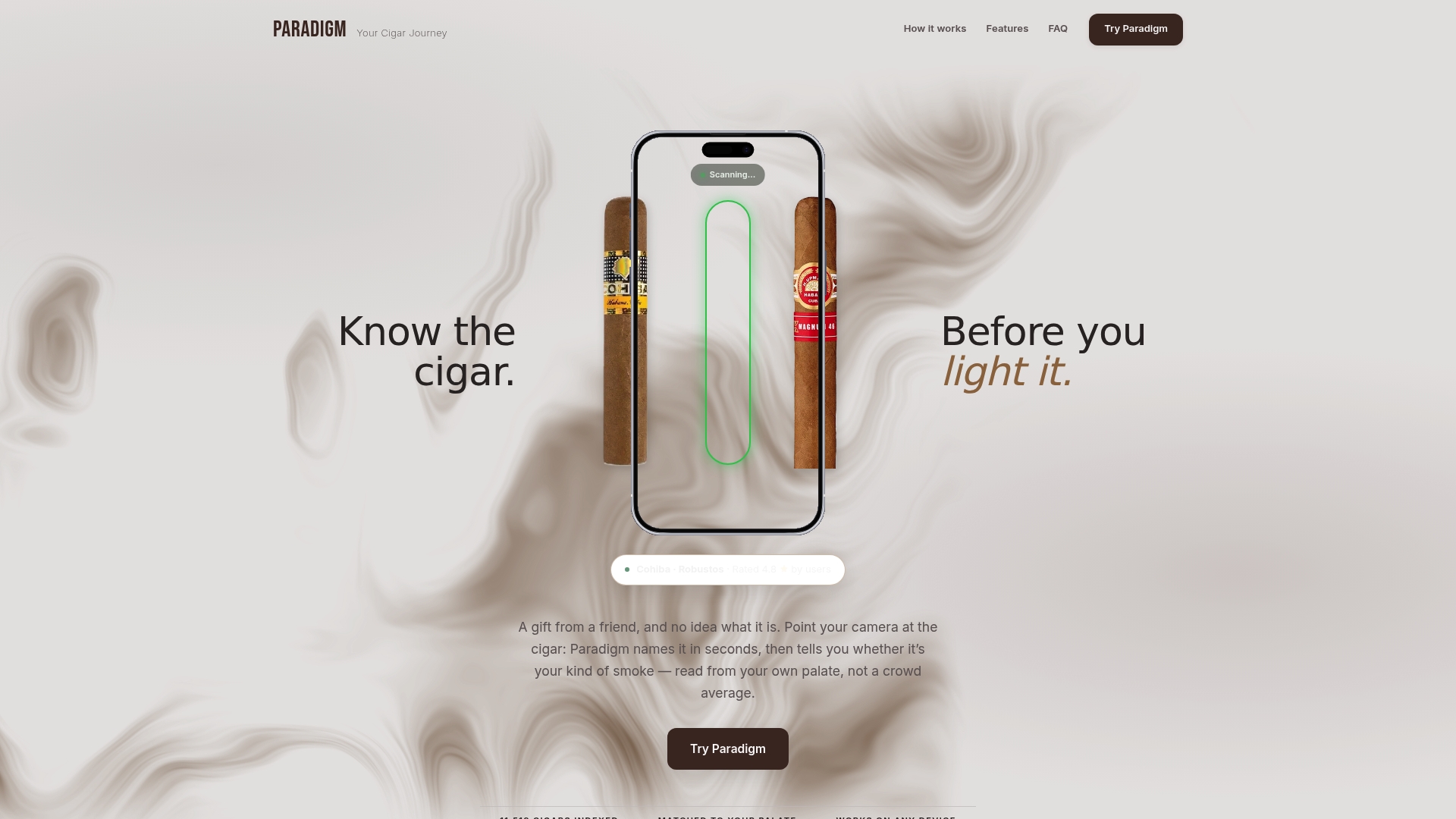
A few features map directly onto the steps above:
- Scanning the whole cigar — band, wrapper, shape, and cap — pulls up its identity and details in seconds instead of a manual search.
- A Tasting Match weighs your preferred strength and flavor against the cigar before you light it.
- A private, searchable smoking history holds your tasting notes and buy-again flags.
- A palate profile sharpens recommendations as you record more cigars.
It runs as a progressive web app, letting you add it to your phone's home screen without a native download. If you want to try the workflow with less manual tracking, start with Paradigm and scan your next cigar before you smoke it.
FAQ
What's the best way to research a cigar before buying it online?
Identify the exact cigar and size, pull one method-transparent professional review plus a few community impressions, and extract strength, flavor, and construction notes. Filter by your own strength and flavor preferences first, and use the score only to break a tie between similar options.
How do I know if an online cigar review is trustworthy?
Check whether the publication explains its tasting method, including whether it uses blind tasting, since that reduces brand and price bias. Cross-check the review against community impressions rather than relying on a single source.
What should I write down in a cigar tasting journal?
Record the cigar's identity, size, date, strength and body, dominant flavor families with specific notes by third, draw and burn, finish, your own rating, and a buy-again flag. Scoring construction, draw, flavor, and value separately, as in the Kaufmann journal framework, gives a clearer record than one overall number.
How can I tell if a cigar is a good match for my palate before smoking it?
Compare its strength category and dominant flavor families against your own tasting history rather than relying on the score alone, since an 89-point mild cigar can suit you better than a higher-scored full-bodied one. A personalized Tasting Match, like the one built into Paradigm, does this comparison automatically based on your logged preferences.
How do I avoid buying counterfeit cigars when shopping online?
Buy from an authorized or well-established retailer, be cautious of prices far below market rate, and cross-check band and packaging details against known authentic examples. Community forums often have comparison photos of real versus counterfeit bands that make the differences easier to spot.
Sources
- A New Look At Our Cigar Reviews | Cigar Aficionado
- How Cigar Aficionado Tastes Cigars | Cigar Aficionado
- Kaufmann tasting journal (framework) | Cigar Cocktail Magazine