Best Cigar Recommendation App: See Why AI Picks Your Next Cigar

For personalized cigar discovery, we recommend an app built around whole-cigar recognition that reads the band alongside wrapper, shape, and cap details, a large catalog, and an explainable AI tasting match. Paradigm fits that description and is the clearest example of how the approach works in practice. Below, we walk through the features worth checking for, how the matching logic works, and how to put it to use so you can find cigars that actually suit your palate.
TL;DR:
- Prioritize metadata depth over raw catalog size, and confirm that a failed scan can fall back to searchable manual entry.
- Record a consistent score, strength, and two or three flavor notes after each smoke; sparse or rushed entries weaken personalization.
- Treat match scores as directional, not guarantees: test five or six strong suggestions across different strengths over a few weeks, then compare your ratings.
- Frequent smokers benefit most from discovery tracking, while occasional smokers or loyalists to a few blends should test the free tier before subscribing.
What to Look for in a Cigar Recommendation App
Most cigar apps promise discovery, but the features behind that promise vary a lot. A Reddit thread on cigar apps points out that cigar-specific apps are still a small field, and scanner-style tools tend to come up as the most practical option people actually use. That matches what we have seen: the apps worth your time share a handful of concrete features rather than vague marketing language.
Here is what actually matters when you are sizing one up:
- Catalog breadth and metadata: a wide catalog with origin, wrapper, and blend details lets the app tell you something useful about a cigar, not just its name.
- Whole-cigar scanning with a manual fallback: a scan should identify a cigar in seconds by reading its band, wrapper, shape, and cap together, and when the scan fails, a searchable catalog should let you find it by hand.
- Tasting journal and searchable history: every rating and note you log builds a record the app can use to understand your palate over time.
- Personalized recommendations with an explanation: a strong match tells you why a cigar fits, not just that it does.
- Community and critics' ratings alongside your private notes: aggregated opinions are useful context, but your own logged preferences should carry more weight for your personal matches.
- Filters for flavor tags, strength, and curated lists: sliders and tags speed up discovery when you already know roughly what you want.
- Cloud sync and backup: your tasting history should survive a lost phone or a new device.
A first-party rundown of what to look for in a cigar tracking app breaks these criteria down in more detail if you want to compare options side by side.
Catalog size deserves a second look because it is easy to overstate. A database with thousands of entries sounds impressive, but if half the entries lack wrapper or origin data, the recommendation engine has little to work with. Metadata depth matters as much as raw count.
Whole-cigar scanning is the feature most people notice first, since it is the fastest way to identify an unfamiliar cigar at a shop or a lounge. But scans fail sometimes: a damaged band, bad lighting, or a limited-release blend not yet in the catalog will all trip up recognition. An app that falls back gracefully to manual search, rather than leaving you stuck, is doing the job right.
The journal and history features matter more than they seem at first glance, because they are what feeds the recommendation engine. An app with great scanning but a thin journal still cannot personalize much, since it has nothing to learn from.
Pro Tip: Log a cigar's strength and two or three flavor notes every time, even when you are in a hurry. Thin entries produce thin recommendations.
How an AI-Powered Tasting Match and Palate Profile Actually Work
Recommendation engines in this category generally work off a profile built from your own ratings, not a generic popularity score. Paradigm's version of this is a five-dimension palate profile that sharpens with each entry you log, gradually weighting your preferences for strength, wrapper type, and flavor categories like pepper, cedar, or sweetness as you add more tasting notes.
The practical workflow is simple: scan the cigar, band and all, to pull up its record, and when scanning does not recognize it, search the catalog manually by name or brand. Either path lands you on a cigar page with its metadata and, if you have logged enough preferences, a Tasting Match score.
What makes a match explainable rather than just a number is the reasoning behind it. A useful match looks something like this:
Because you prefer medium strength and cedar notes, this cigar scored high for you. Its profile also includes a touch of pepper, which you have rated favorably in similar blends.
That kind of explanation lets you judge whether the logic makes sense for your own palate, rather than trusting a black box. Paradigm's blog describes this matching logic as pulling from your preferred strength and flavor profile to flag a cigar as likely or unlikely to suit you, with the reasoning included.
"Likely" and "unlikely" are directional signals, not guarantees. The way to sanity-check them is to run a small validation sample: pick five or six cigars the app flags as strong matches across a range of strengths, smoke them over a few weeks, and rate each one honestly. If most land where you expected, the profile is working. If several surprise you, it usually means your logged history is still too thin or too narrow in flavor range for the engine to generalize well.
How to Use an App Day to Day to Discover Cigars You'll Enjoy
Getting good recommendations is less about the algorithm and more about what you feed it. The workflow is short enough to build into a normal smoking session.
- Scan the cigar before you light up, letting the app read the band along with its wrapper and shape, or search manually if the scan does not recognize it.
- Smoke the cigar paying attention to how the flavor shifts across the first, second, and last third.
- Rate it on a consistent numeric scale right after you finish, while the experience is still fresh.
- Add a short note covering two or three flavor tags and how the strength felt to you.
- Check your updated recommendations every few sessions to see how the suggestions shift as your profile fills in.
A structured 1 to 10 scoring approach broken into thirds works well here, since it forces you to notice how a cigar changes rather than giving one flat score for the whole smoke.
Before your first few sessions, set your baseline flavor and strength preferences in the app so early recommendations have somewhere to start. From there, an accuracy check is worth doing deliberately: pick two or three cigars the app rates as likely matches, smoke them specifically to test the call, and compare your score against the predicted match. That single exercise tells you more about how well the engine fits your palate than weeks of casual use.
Pro Tip: Sample outside your usual comfort zone every so often. A profile built only from one wrapper type or one strength band will recommend more of the same, which defeats the point of discovery.
Consistency matters more than volume. A handful of carefully scored cigars with real notes will refine your profile faster than dozens of rushed, one-line entries.
Platform, Access, and Pricing: Choosing for Convenience
Most cigar apps in this space run as either a native app or a progressive web app, and the difference affects how you use them day to day.
- Progressive web apps install straight from your browser, work across phone and desktop without an app store, and sync your data automatically between devices.
- Native apps sometimes offer deeper offline functionality, but you will want to check store listings for iPhone versus Android separately, since feature parity is not always guaranteed.
- Free and freemium tiers typically cover basic scanning and journaling, while premium tiers tend to unlock larger catalog access, advanced filters, and data export.
- Offline logging is worth checking before you travel, since photo storage and syncing can behave differently without a signal.
For most smokers, a progressive web app removes the friction of downloads and store approval delays, which matters more than it sounds once you just want to scan a cigar at a shop.
Author Perspective: Who Benefits Most From an App-Driven Discovery Workflow
An app-driven workflow earns its keep fastest for frequent smokers: people sampling widely, building a collection, or actively trying to pin down their palate. The more cigars you log, the faster the profile sharpens, and the more the recommendations start to feel genuinely personal rather than generic.

Occasional smokers and single-brand loyalists get less out of it. If you smoke the same two or three blends you already know you like, a recommendation engine has little to add, since there is no real discovery problem to solve.
Our honest advice: test the free tier or a small sample set of cigars before committing to a subscription. A few weeks of real logging will tell you faster than any feature list whether the matching logic fits how you actually smoke.
— Yaro
Paradigm: Recommended Option for Personalized Cigar Recommendations
We built Paradigm as a browser-based progressive web app, so you can add it to your home screen without a store download. Our catalog covers a large number of cigars, and scanning the cigar — band, wrapper, shape, and cap together — pulls up a full record in seconds. When a scan does not land, our manual search covers the same catalog.
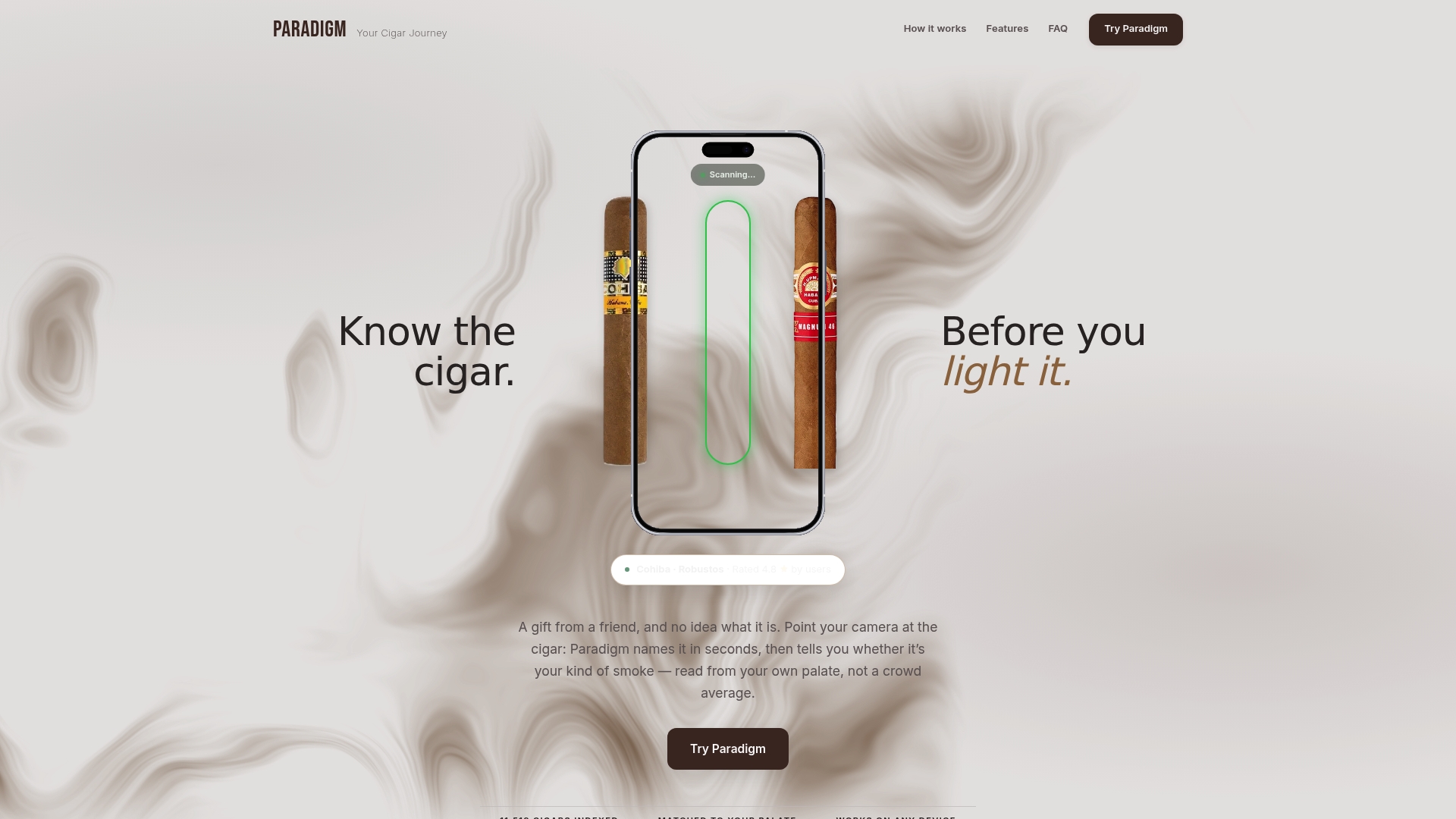
Our five-dimension palate profile sharpens with every rating you log, feeding a Tasting Match that tells you not just whether a cigar fits, but why. Your ratings, notes, and smoking history stay private and searchable, synced to the cloud so a new phone never means starting over.
| Checklist item | How we handle it |
|---|---|
| Catalog breadth | A large collection of Cuban and New World cigars |
| Band identification | Photo-based scan of the whole cigar, with manual search as fallback |
| Personalization | Five-dimension palate profile, explainable Tasting Match |
| Data and sync | Private searchable history, cloud backup |
| Access | Progressive web app, no app store required |
If you want recommendations that explain themselves instead of guessing, try Paradigm and start building your tasting history today.
FAQ
Is a $20 cigar good?
Price alone does not determine quality; a cigar can be excellent or underwhelming depending on the blend, construction, and your own palate. Logging your ratings across different price points in a tasting journal is a more reliable way to learn what actually suits you than price as a shortcut.
What is the 135 rule for cigars?
The "1-3-5" guidance some smokers reference is a casual rule of thumb for how many cigars to keep on hand at different collecting stages, not a formal standard. It varies by source and personal preference, so treat it as a loose starting point rather than a fixed rule.
Who smoked 40 cigars a day?
This is a commonly repeated piece of cigar trivia, but no single authoritative record ties a specific, verifiable figure to a named historical smoker. Treat claims like this as folklore rather than documented fact.
What is the best cigar app for iPhone?
The strongest option for iPhone is a progressive web app like Paradigm, which installs from your browser without needing an App Store listing and works the same way across iOS, Android, and desktop. That cross-device consistency avoids the feature gaps that sometimes show up between native iOS and Android versions of other apps.
How do I choose cigars using an app?
Start by scanning the cigar you are curious about — its band along with the wrapper and shape — or searching it manually, then check its Tasting Match against your logged strength and flavor preferences. Over time, your ratings and notes refine the match, making each new suggestion more specific to your palate than a generic bestseller list.
Sources
For more on the workflow and reasoning behind app-based cigar discovery, see Paradigm's comparison of cigar-tracking apps, the 1 to 10 tasting workflow, and what to look for in a tracking app. The r/EveryDayIsCigarDay discussion on cigar apps offers community perspective, and Thor's Cigar Vault's storage guide covers humidor care for your collection.
- Cigar Apps? : r/EveryDayIsCigarDay