Best Cigar Tasting App for Enthusiasts: Structured Tastings, Humidor

We recommend Paradigm as the best cigar tasting app for enthusiasts who want a structured tasting workflow paired with real humidor tracking. It combines whole-cigar scanning—reading band, wrapper, shape, and cap—across a catalog of more than 11,500 Cuban and New World cigars, a personalized Tasting Match, and a private searchable smoking history, all accessible as a browser-based app with no native install required. The at-a-glance comparison below shows exactly why it fits that role.
TL;DR:
- The catalog covers more than 11,500 Cuban and New World cigars, while manual search handles faded bands or items the scanner cannot identify.
- Use structured entries for cigar specifications, prelight observations, each of the three smoking thirds, and the finish; consistent flavor tags keep later comparisons searchable.
- Tasting Match compares a cigar’s profile with your preferred strength and flavors, then explains its likely fit; keep your profile current because recommendations depend on it.
- The app runs in a browser and syncs notes across devices; a home screen shortcut avoids app store installation and phone storage use.
At a Glance: How the Top Cigar Apps Compare
Before you commit to any single app, it helps to see how the main evaluation dimensions stack up side by side. We built this table around the features that actually change your tasting experience: identification method, tasting workflow depth, humidor limits, recommendation quality, platform type, and privacy handling.
The pattern that stands out: most dedicated cigar apps handle identification or basic logging well, but few combine scanning, a structured tasting vocabulary, and a recommendation engine in one place. Apps built around community feeds, like Cigar Dojo or Boxpressd, lean toward social sharing rather than private pattern tracking, while general note tools like Evernote offer flexibility but no cigar-specific structure at all.
If you're an enthusiast who wants to log a session in under two minutes and still build a reliable record of what you actually enjoy, a tool with both structured fields and a flavor-matching engine will save you the most time over a full humidor's worth of smokes.
Before your first session, run through this short checklist:
- Add the app to your home screen if it's browser-based, so it opens like a native app without using phone storage.
- Set up a basic tasting template with fields for wrapper, strength, and flavor tags before you light anything.
- Scan or search your first two or three cigars to confirm the catalog recognizes your usual picks.
What Makes a Great Cigar Tasting App
A cigar app earns its place in your pocket by getting a handful of fundamentals right, not by piling on features you'll never open.
Identification accuracy matters because flavor context starts with knowing exactly what you're smoking. A scan that correctly reads wrapper, origin, and blend gives you a baseline before the first draw; a vague or wrong match sends your notes down the wrong path entirely.
Tasting vocabulary separates a casual log from a useful one. The Certified Cigar Reviews framework from Tobacconist University structures evaluation into cigar specs, pre-smoke, the three smoking thirds, and post-smoke finish, with concrete fields like construction, combustion, aroma, taste, strength, body, and overall rating. An app that mirrors this structure, rather than offering one free-text box, helps you compare sessions months apart.

Search and filters let you find cigars by flavor, strength, or past rating instead of scrolling a flat list. This only works if your tasting fields are consistent enough to filter on, which is why vocabulary and search are really the same problem viewed from two angles.
Humidor and syncing cover the practical side: how many cigars you can track, whether you can export your data, and whether your notes survive a phone upgrade. Cloud backup matters more than it seems until the day your phone dies mid-aging-log.
Platform and privacy round out the list. A progressive web app (PWA) skips the app-store install and still supports add-to-home-screen access, while private notes keep your palate preferences off a public feed unless you choose to share them.
- Identification: scan or search accuracy sets the context for every note you write afterward.
- Vocabulary: structured fields beat free text for long-term pattern recognition.
- Search: flavor and strength filters only work when your past entries are consistent.
- Sync and privacy: cloud backup protects your history; private-by-default protects your preferences.
Pro Tip: Pick an app that lets you tag both a general flavor category and a specific descriptor, like "earthy, leather" rather than just "earthy." The extra detail pays off once you have dozens of entries to compare.
How a Tasting App Should Handle Identification and Journaling
The gap between a decent cigar app and a genuinely useful one shows up the moment you try to log a real session, not in the marketing copy.
Identification should start with a scan of the whole cigar—covering band, wrapper, shape, and cap—with manual search as the fallback when the band is worn, dim, or simply not in the catalog yet. Paradigm's approach scans the whole cigar rather than relying on the band alone, which helps when a wrapper has faded or a band has slipped. Behind that scan sits a catalog of over 11,500 Cuban and New World cigars, wide enough that most regular smokes are recognized on the first try, with manual search covering the rest.
Journal fields matter more than any single feature on this list. The CCR worksheet lays out cigar specs (vitola, length, ring gauge, wrapper, binder, filler), pre-smoke observations, the three smoking thirds, and post-smoke finish and overall rating. A well-built app maps its own fields onto that same structure: specs at the top, a thirds-based scoring section in the middle, and a finish and pairing note at the end. Paradigm uses a six-family flavor vocabulary to keep tagging consistent across sessions, which matters more than it sounds. Aroma research on filler tobacco identified 56 distinct aroma compounds across five growing regions, with differences showing up as woody, floral, or burnt-sweet notes. That range of real sensory variation is exactly why a single "good or bad" rating throws away most of the useful information in a session.
- Whole-cigar scanning with manual search as a fallback keeps logging fast even when a wrapper is faded.
- Structured specs, thirds, and finish fields turn a note into a comparable record.
- A consistent flavor vocabulary lets you filter sessions by descriptor months later.
- Private-by-default notes keep your palate data yours unless you choose to share it.
Recommendations work best when they're built on your own history rather than a generic popularity list. Paradigm's Tasting Match compares a cigar's profile against your preferred strength and flavor profile and returns a plain explanation of why it's likely or unlikely to suit you, before you light it. That kind of upfront signal is only as good as the data behind it, so it's worth checking in occasionally: our guide on what to do when cigar recommendations aren't accurate walks through the usual fixes, which are almost always about tightening your own profile rather than the algorithm failing.
Humidor management covers inventory, aging notes, and movement between storage spots, plus the ability to export your list if you ever switch tools. A record that only lives on one device isn't a record, it's a risk.
A statistic worth keeping in mind: the same aroma study found measurable sensory differences tied to tobacco region and part, which is the scientific case for apps that support more than one flavor dimension per entry. A single star rating can't capture that kind of variation; a tagging system built around several descriptors can.
Privacy and PWA behavior round things out. Adding a browser-based app to your home screen gives you near-native convenience without an app-store download, and cross-device sync through the cloud means your notes follow you from phone to laptop. Community and critics' ratings can sit alongside your private entries without ever exposing your personal notes unless you choose to publish them.
Build a Tasting Template You'll Actually Use
A tasting template only earns its keep if you fill it out the same way every time, which is the entire point of structure over free text.
The CCR framework breaks a review into four stages: cigar specs, pre-smoke observation, the three smoking thirds, and post-smoke finish. You can paste a version of this into any journal app, including Paradigm, in a few minutes.
- Cigar specs: brand, vitola, length, ring gauge, wrapper, binder, filler origin.
- Pre-smoke: wrapper appearance, aroma before lighting, draw resistance when cold.
- First third: construction, combustion, initial flavor and strength notes.
- Second third: flavor shift, body changes, any harshness or sweetness.
- Final third: intensity change, common in a hotter and more concentrated finish, plus any bitterness.
- Post-smoke: finish length, aftertaste, pairing notes, and an overall rating out of ten.
Our own breakdown of the 1-10 scoring and thirds workflow goes deeper into how to score each third consistently, and the 70/20/10 framework for setting preferences is a useful companion once you've logged enough sessions to see a pattern.
Flavor tagging works best when you separate a broad category from a precise descriptor: "spice, black pepper" tells you more six months from now than "spicy" alone. Our guide to how cigar flavor categories are defined covers terms like barnyard and leather that trip up newer tasters.
Pro Tip: Keep your descriptor list short and fixed rather than inventing new words each session. Twenty consistent tags beat two hundred one-off phrases when you're trying to spot your own patterns.
How We Evaluated and Selected This Recommendation
We weighted this recommendation around four criteria, in order: tasting workflow depth, identification reliability, humidor and privacy handling, and platform accessibility.
- Tasting workflow depth: how closely an app's fields map to the structured Certified Cigar Reviews framework rather than a single free-text box.
- Identification reliability: whether scanning or search can reliably match a cigar to catalog metadata, with a manual fallback when it can't.
- Humidor and privacy: whether users can track inventory, export data, and keep personal notes private by default.
- Platform accessibility: whether the app works across devices without requiring a native install.
We checked product documentation for each app, cross-referenced tasting methodology against the CCR worksheet, and reviewed peer-reviewed aroma chemistry research to confirm why multi-dimensional flavor tagging outperforms a single score. We did not name every competing app's internal features in equal depth, since our own product, Paradigm, is one of the options in this category and we built the comparison around the same criteria we'd apply to any entrant.
Switching From Paper or Generic Notes to a Dedicated App
Moving from a paper notebook or a general note app to a dedicated tasting tool is less about technology and more about discipline. A structured app forces consistency that a blank page never will, and that consistency is what eventually reveals your own palate patterns. The trade-off is a short learning curve: your first few entries will feel slower than a quick scribble.
A browser-based, PWA-first app removes one layer of friction entirely. No app-store queue, no storage eaten up by a native install, just a home-screen icon that opens instantly on whatever device you have in hand.
— Yaro
Try Paradigm for Your Next Tasting Session
We built Paradigm around the tasting workflow enthusiasts actually want: scan the whole cigar—wrapper, shape, and cap—against a large catalog, log your session with structured fields, and get a personalized Tasting Match before you light up.
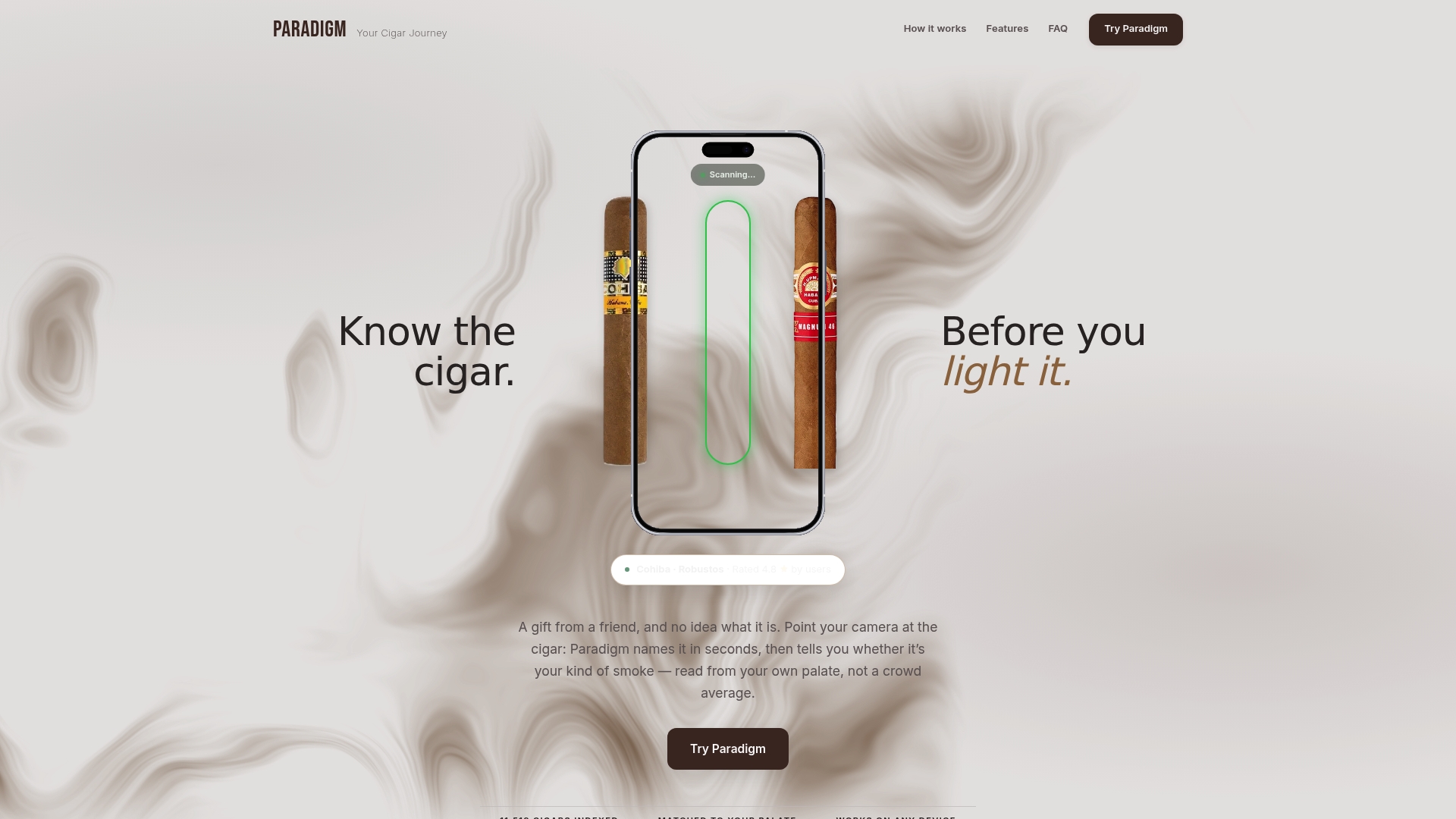
- Scan or search to identify a cigar instantly from our catalog.
- Record thirds-based tasting notes using a consistent six-family flavor vocabulary.
- Get a Tasting Match explanation based on your preferred strength and flavor profile.
- Keep a private, searchable smoking history that syncs across devices.
| Feature | What it gives you |
|---|---|
| Band and photo scanning | Fast identification without typing a search |
| 11,500+ catalog | Broad coverage of Cuban and New World cigars |
| Tasting Match | Personalized fit guidance before you smoke |
| Private searchable journal | A record only you control, backed up to the cloud |
Add Paradigm to your home screen, build your first tasting template, and scan your next cigar before you light it. Start at Yourparadigm.
FAQ
What is the 135 rule for cigars?
There's no single standardized "135 rule" recognized across major tasting frameworks like Certified Cigar Reviews. If you've seen it referenced, it likely refers to a personal storage or rotation guideline rather than an industry-wide standard, so treat it as informal advice rather than a fixed rule.
Who smoked 40 cigars a day?
This article focuses on tasting apps and tasting methodology rather than historical smoking habits, and we don't have a sourced reference for this claim. Heavy daily cigar use of any amount carries real health risks, as outlined in public health reviews of combusted tobacco products.
Is a $20 cigar good?
Price alone doesn't determine quality since construction, wrapper origin, and blend matter more than cost. A structured tasting log is the most reliable way to find out whether a $20 cigar suits your own palate, regardless of its price point.
What are the best online cigar sites?
Online cigar retailers vary by region and legal shipping restrictions, so the right source depends on where you live. Pairing a purchase from a trusted retailer, such as Thor's Cigar Vault, with a consistent tasting log in an app like Paradigm helps you track whether a new find actually matches your preferences.
How do I taste cigars properly?
Proper tasting follows a structured sequence: examine the cigar before lighting, then evaluate construction, flavor, and strength across each of the three smoking thirds, and finish with notes on aftertaste and overall rating. The Certified Cigar Reviews framework is the clearest reference for this structure.
Sources
- Certified Cigar Reviews™ | Cigar Evaluation | TU
- Aroma precursors of cigars from different tobacco parts and origins, and their correlations with sensory characteristics