3 Flavor Clues to Tell Indonesian vs Ecuadorian Sumatra Wrappers

Sumatra wrapper typically brings an earthy, sweet-spice character, think cinnamon, cedar, and floral notes, paired with a thin, silky leaf that burns cleanly and evenly. Indonesian-grown Sumatra tends to run milder and more aromatic, while Ecuadorian Sumatra leans sweeter, spicier, and fuller in body. Either way, you're dealing with one of the more approachable wrapper types in the humidor.
TL;DR:
- Indonesian Sumatra wrappers are milder and more aromatic, offering subtle sweetness and floral notes, making them ideal for lighter blends.
- Ecuadorian Sumatra offers a sweeter, spicier, and fuller-bodied profile due to its shade-grown cultivation, suitable for bold, flavor-forward cigars.
- Sumatra's flavor profile centers on earth, sweet spice, notably cinnamon, cedar, and faint floral notes, which remain prominent throughout all thirds of the cigar.
- The wrapper's thinness requires careful storage at proper humidity to prevent cracking, and to taste the full flavor profile, a slow, gentle light is recommended.
- Popular cigars with Sumatra wrappers include full-bodied Ecuadorian Sumatra blends, Ecuadorian-wrapper Nicaraguan-filler blends, milder Sumatra-wrapped blends, and balanced medium-bodied Ecuadorian Sumatra blends.
Sumatra Wrapper Flavor Profile: What You'll Actually Taste
The core Sumatra wrapper flavor is built around three things: earth, sweet spice, and wood. Cinnamon shows up more than any other spice descriptor, often alongside cedar and a faint leather note that deepens as the cigar burns down. Retailer guides and hobbyist explainers consistently list cinnamon, sweet spice, earth, and cedar as the baseline Sumatra vocabulary, and that list holds up whether you're smoking a mild Connecticut-style blend or something with more punch.
Behind those primary notes sit quieter background flavors: floral top notes, dried herbs, sometimes a light cocoa dusting. Some aged Indonesian Sumatra leaf even carries a chewy, white-bread sweetness with a faint rubber note in certain phenotypes, an unusual descriptor, but one that leaf suppliers document consistently in their tasting notes.
When you retrohale a Sumatra-wrapped cigar, expect the cinnamon and cedar to sharpen, while the earth note tends to flatten out into something closer to damp wood.
Here's how to read the wrapper before you even light up:
- Body and strength: Mild to medium-bodied in most cases, rarely a strength bomb on its own.
- Mouthfeel: Silky, almost papery texture on the tongue, a signature of the thin leaf structure.
- Color range: Light brown to reddish-brown, with a slight sheen when properly humidified.
- Aroma before lighting: Sweet hay and cedar, occasionally a floral lift.
Pro Tip: If you're new to identifying Sumatra notes, smoke it side by side with a Connecticut shade wrapper. The cinnamon and cedar in Sumatra will jump out immediately by comparison.
Indonesian Sumatra vs. Ecuadorian Sumatra: Why They Taste Different
The two variants share a name but not much else on the palate. Indonesian Sumatra leaf tends to be thinner, aromatic, and milder, often used for its delicate sweetness and floral or earthy aromatics rather than punch. Ecuadorian Sumatra, grown from Sumatra seed but cultivated under Ecuador's cloud cover, is often sweeter and shows more baking spice and fuller body compared with its Indonesian counterpart.
That gap traces back to growing conditions, not just seed genetics. Ecuador's overcast skies act like natural shade cloth, and that cloud cover and soil composition contribute to sweeter, fuller flavor expression in the finished leaf. Indonesia's more direct sun and different curing traditions push the leaf toward a lighter, more aromatic result instead.
Here's how the two typically compare on the shelf:
- Indonesian Sumatra: Mild, aromatic, subtle sweetness, best for blends where you want the wrapper to whisper rather than shout.
- Ecuadorian Sumatra: Sweeter, spicier, fuller body, better when you want the wrapper flavor to lead the smoke.
- Terroir factor: Ecuador's cloud cover softens sun exposure similarly to shade-grown tobacco, which is part of why it reads richer despite sharing Sumatra genetics.
If you gravitate toward a quieter, more contemplative smoke, reach for Indonesian Sumatra. If you want the wrapper doing some of the heavy lifting on flavor, Ecuadorian Sumatra delivers more up front.
How Sumatra Wrapper Shapes the Smoke Through All Three Thirds
Wrapper leaf contributes a disproportionate share of what you taste, especially in the first third, before filler and binder fully assert themselves. Sumatra's role changes as the cigar burns down, and tracking that shift is one of the fastest ways to train your palate.
- First third: Sweet spice and floral top notes dominate. This is where cinnamon and cedar tend to be most distinct.
- Middle third: Earth and leather build as the filler blend takes over more of the flavor load, though Sumatra's aromatic lift usually still lingers on the retrohale.
- Final third: Notes concentrate and intensify. Cedar often turns woodier, and any pepper in the blend becomes more noticeable against the softer wrapper base.
A short checklist helps you log this consistently. Before lighting, note the wrapper's color and aroma. At the start of each third, jot one dominant flavor and one background note. At the end, rate how the finish changed from light to last third.
Pro Tip: Keep your notes in the same format every time, even shorthand works, so you can compare Sumatra-wrapped cigars against each other months later instead of relying on memory.
Commercial Cigars That Showcase Sumatra Wrapper Flavor
Retail top-lists converge on a fairly small, consistent set of Sumatra-wrapped cigars, which makes them useful benchmarks for training your palate.
- Full-bodied Ecuadorian Sumatra blend: Delivering cedar and dark cocoa, great for readers who want fuller body without harshness.
- Ecuadorian Sumatra wrapper over Nicaraguan filler: Showing sweet spice up front with real depth.
- Milder Sumatra-wrapped blend: Floral and cedar notes, suited to readers easing into Sumatra characteristics.
- Balanced Ecuadorian Sumatra blend: Known for balanced sweetness and medium body, a reliable reference point.
- Earthier, woodier Sumatra blend: Useful for tasting the background notes rather than the sweet-spice front.
- Infused Sumatra blend: The Sumatra base gets layered with additional aromatics, good for pairing practice.
- Bolder, spice-forward Ecuadorian Sumatra blend: For readers who want Ecuadorian Sumatra pushed toward the front of the profile.
Storing and Smoking Sumatra Wrappers Without Wrecking the Leaf
Sumatra's thinness is part of its charm and part of the risk. Retailer guidance consistently warns that Sumatra wrappers can crack if stored at too low humidity because the leaf simply has less material to absorb shock.
- Humidity target: Keep your humidor at an appropriate relative humidity level recommended for wrapper leaf storage.
- Cracked wrapper fix: A small crack near the foot usually won't ruin the smoke, just avoid pressing on it while handling.
- Lighting tip: Toast slowly and rotate the foot; thin leaves scorch faster than thicker Connecticut or Habano wrappers.
- Pairing suggestion: A dark rum or a lightly peaked whiskey complements the cinnamon and cedar notes well, while black coffee tends to mute the floral background.
Pro Tip: If a Sumatra wrapper feels dry to the touch before you smoke it, let it rest in your humidor for 48 hours rather than lighting it immediately. Rushed rehydration is a common cause of unwanted seam splits.
A Practical Checklist for Tasting Sumatra Cigars
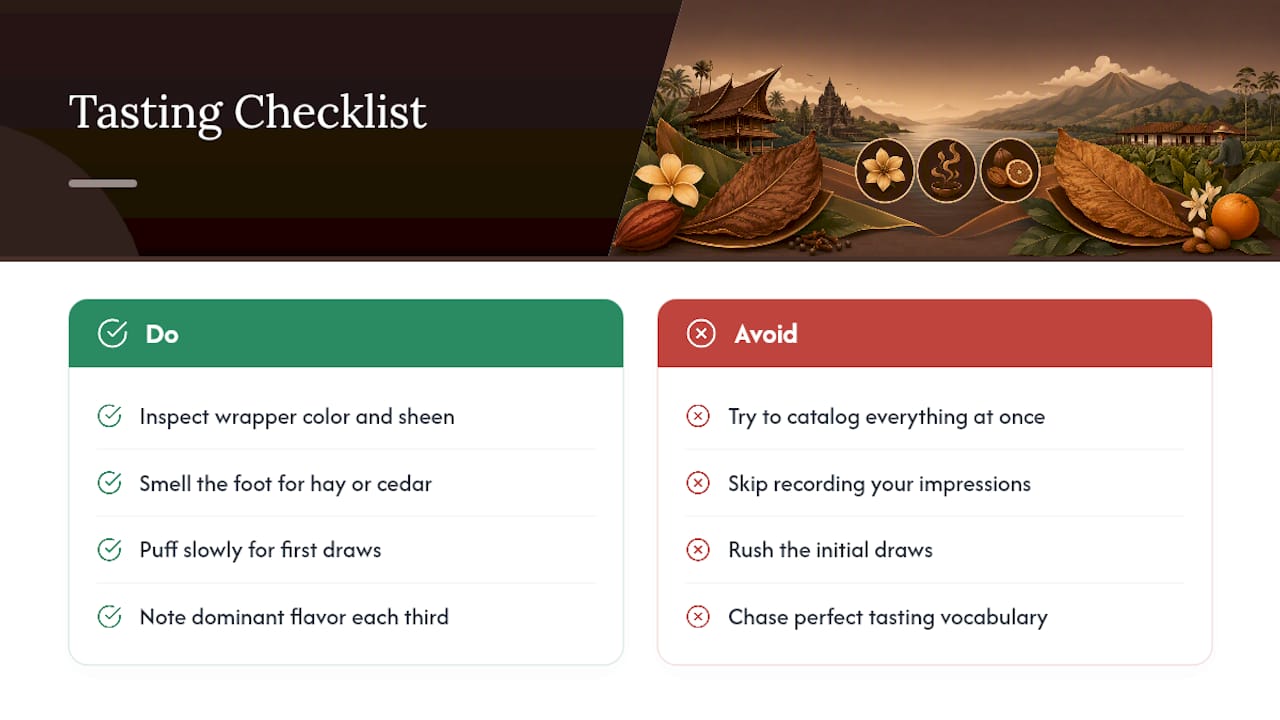
Before you light up, look at the wrapper's color and sheen, then smell the foot for that sweet hay or cedar lift. Once lit, puff slowly for the first few draws and pay attention to what hits first: sweet spice usually announces itself before earth does.
I'd note the dominant flavor at the start of each third rather than trying to catalog everything at once. That single habit does more for palate development than any tasting wheel. Logging entries in something like Paradigm's cigar journal or even a plain notebook turns a one-off impression into a pattern you can actually compare across different Sumatra-wrapped cigars over months. The goal isn't perfect vocabulary on smoke one, it's consistency, so smoke ten looks back at smoke one and tells you something real.
— Yaroslav
Track Your Sumatra Tasting Notes With Paradigm
Recognizing Sumatra wrapper flavor gets easier once you have a consistent way to record it. There are cigar journals that let you scan a cigar, recognizing its band, wrapper, shape, cap, and dimensions, to pull up details from a large catalog of cigars, then log tasting notes, rate the smoke, and build a private smoking history you can search later.

Some cigar journals ask for your preferred strength and flavor profile to flag whether a given Sumatra-wrapped cigar is likely to suit your palate before you buy it, and explain why. Such personalized features can become more accurate the more smokes you log, which speeds up pattern recognition. Many operate as progressive web apps, allowing you to add them straight to your phone's home screen with no download required. Start building your cigar journal and see how your palate profile sharpens after a few Sumatra-wrapped entries.
Sources
- Why the cigar industry loves Ecuador’s outstanding wrapper leaf — Cigar Journal
- Indonesian Sumatra Long Filler - Indonesian Tobacco Leaf Cigar Filler - All Leaf
- All About Sumatra Wrappers — Holt's Clubhouse
- Top 10 Sumatra wrapper cigars — JR Blending Room
FAQ
What Is a Sumatra Wrapper?
A Sumatra wrapper is a thin, aromatic tobacco leaf originally grown on the Indonesian island of Sumatra, now also cultivated in Ecuador from the same seed lineage, prized for its earthy, sweet-spice flavor and silky texture.
What Makes Sumatra Wrapper Tobacco Special?
Its thinness and aromatic oils give it a distinct cinnamon, cedar, and floral profile that Connecticut and Habano wrappers don't replicate, while still burning cleanly when properly humidified.
What Are the Best Cigars With a Sumatra Wrapper?
Widely cited examples include full-bodied Ecuadorian Sumatra blends, Ecuadorian-wrapper Nicaraguan-filler blends, milder Sumatra-wrapped blends, and balanced medium-bodied Ecuadorian Sumatra blends, each showcasing a different balance of sweetness, spice, and body.
What Does "Sumatra" Mean on a Cigar Label?
It refers to the wrapper leaf's seed origin, either grown on the Indonesian island itself or cultivated in Ecuador using Sumatra seed, and signals a milder-to-medium smoke with sweet-spice and earthy characteristics rather than heavy pepper or ammonia notes.
How Do I Know if I'll Like a Sumatra-Wrapped Cigar?
Matching a cigar's strength and flavor profile to your own preferences is easier when you track past smokes, which is exactly what a tool like Paradigm's Tasting Match feature is built to help with over time.
Recommended
- What should I expect from a cigar based on its wrapper colour and shape, before I even light it?
- What's actually different between a Cuban cigar and a 'New World' cigar?
- Why does a cigar taste completely different by the last third than it did at the start?
- Where in the world does cigar tobacco actually grow, and why does it matter?