Use a Tasting Journal to Search Cigars by Flavor and Find Matches
Yes, you can search cigars by flavor, and it's more reliable than shopping by brand or box art. Pick a flavor family (say, earth and wood), narrow it to two or three subnotes like cedar and cream, then filter by wrapper, region, or strength — understanding the flavor perception differences between tobacco products and other nicotine options can help refine your choices, as explained in Tobacco-free Snus (Nicotine Pouches) vs Vapes – FUZE. A search like "cedar, cream, Connecticut wrapper" points you toward mild to medium cigars almost every time. Start with a flavor wheel or a searchable cigar database, and keep a tasting journal so your results improve with every cigar you smoke.
TL;DR:
- Searching cigars by flavor involves focusing on broad flavor families and filtering by wrapper, region, and strength for more accurate results.
- Flavor notes originate from the tobacco's growing conditions and fermentation, with construction layers like wrapper and filler shaping the profile.
- Using structured tasting logs and flavor wheels improves search precision and helps identify personal preferences over time.
- Matching cigars to drinks and occasions enhances the experience, with a focus on pairing lighter or roasted profiles appropriately.
- Digital cigar journal apps streamline flavor tracking, identification, and personalized recommendations, accelerating palate development and search accuracy.
What Contributes to a Cigar's Flavor
Flavor starts in the field, not the humidor. Tobacco variety and terroir, the soil, climate, and altitude where the plant grows, produce distinct base compounds before a leaf is ever rolled. Cuban seed tobacco grown in Nicaragua's Estelí Valley tends toward pepper and earth, while shade grown Connecticut leaf leans sweet and creamy.
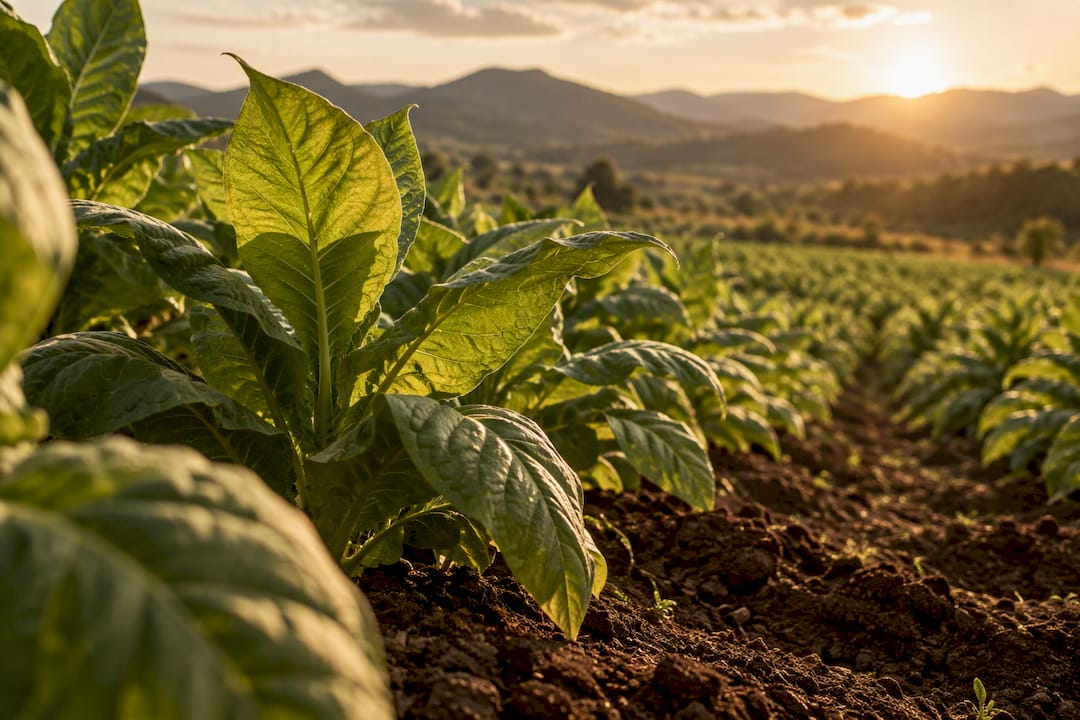
Fermentation is where the real transformation happens. Heat and moisture trigger Maillard reactions and microbial activity that convert raw plant sugars and proteins into roasted, sweet, and savory compounds. A metabolomics study of cigar tobacco leaves identified 109 volatile compounds across different growing regions, including region-specific markers, confirming that where and how a leaf is processed shapes its aroma just as much as the seed variety.
Construction matters too, though not equally across the layers:
- Wrapper supplies the first, most immediate impression on the palate and often the visual cue (dark and oily usually means richer, sweeter notes).
- Filler does the heavy lifting on complexity and depth. Research on tobacco leaf aroma profiles notes that filler often makes up a large majority of a cigar's blend, so it carries most of the core flavor.
- Binder holds the filler together and burns evenly, contributing subtle background notes rather than dominant ones.
- Size, draw quality, and humidor storage conditions all affect how concentrated or muted those flavors taste in the moment.
That's the practical reason wrapper, region, and strength belong in your flavor search alongside taste descriptors. A cedar note from a Connecticut wrapper reads mild and sweet, while cedar from a Nicaraguan Habano wrapper often arrives with more pepper and weight behind it.
Major Cigar Flavor Families and How to Search Them
Trade flavor wheels typically organize cigar notes into six core families, moving from broad categories at the center to specific subnotes at the edge, according to JR Cigars' flavor wheel breakdown. Learning these families gives you a vocabulary that translates directly into search terms.
Pro Tip: Start every search at the family level, not the subnote level. "Earthy" returns more useful matches than "wet forest floor after rain," even if that's exactly what you tasted.
Earth and wood. Cedar, oak, and loam show up constantly in aged, Cuban seed tobacco and darker wrappers. Try searching "cedar, earthy, medium strength" if you want something grounded without heavy spice.
Spice and pepper. Black pepper on the retrohale, white pepper on the finish, and baking spices like clove or cinnamon usually trace back to Nicaraguan Habano wrappers or ligero-heavy fillers. A search for "black pepper, spice, full strength" tends to surface Nicaraguan puros.
Coffee and chocolate (roast notes). Espresso, cocoa, and molasses develop through longer fermentation and darker curing, which is why they cluster around Maduro wrappers. Search "chocolate, coffee, Maduro" for that after-dinner profile.
Nut, cream, and sweet. Almond, cashew, cream, and caramel are the calling cards of Connecticut shade wrappers and milder blends built for approachability. "Cream, nutty, Connecticut, mild" is a reliable beginner-friendly query.
Floral and fruit. Jasmine, dried cherry, and citrus peel are subtler and often show up in aged blends or Cuban seed tobacco grown outside Cuba. Try "floral, dried fruit, medium body" if you want something more delicate than the earthy or spicy categories.
Savory and leather. Leather, hay, and a note enthusiasts call "barnyard" come from extended aging and specific leaf types, particularly ligero and some Cuban seed fillers. A search for "leather, savory, full-bodied" targets that older, more intense character.
Each family overlaps at the edges. A cigar can carry cedar and black pepper at once, which is exactly why a two or three subnote search works better than chasing a single descriptor.
How to Taste and Record Cigar Flavors So You Can Search Them Later
Vague notes produce vague search results. "Tasted good" tells a database nothing; "cream, then cedar, building to black pepper on the last third" gives you something you can filter against next time.
Before lighting up, check the wrapper's oil and color, take a dry draw, and smell the foot of the cigar. These pre-smoke cues often predict the family you're about to taste. Then track flavor through three stages, since taste evolves as the cigar burns down and its heat and composition shift:
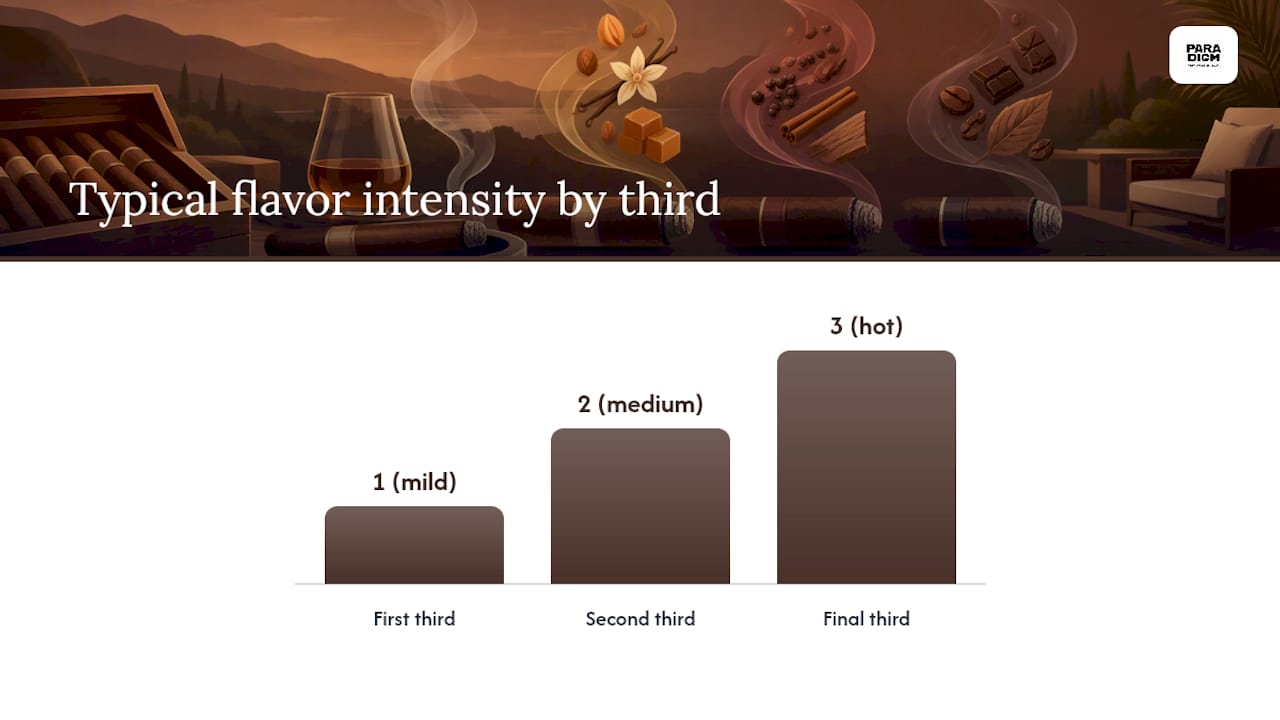
- First third: Usually the mildest, dominated by wrapper-driven notes like cream, cedar, or light pepper.
- Second third: Filler flavors emerge more fully here. Coffee, spice, or leather notes often intensify.
- Final third: Runs hotter and more concentrated. Sweet notes can turn slightly bitter, and pepper often sharpens.
Retrohale, exhaling smoke gently through your nose rather than your mouth, pulls out spice and pepper notes that don't register on the tongue alone. Use it sparingly, maybe once per third, since it fatigues your palate fast if overdone.
A simple record format works best: family, subnote, intensity on a 1 to 3 scale, where in the smoke it appeared, and any pairing notes. Trade guides on staged tasting consistently recommend this kind of structured note over free-form impressions, and the reason is simple: structured notes are searchable, and "it was nice" is not.
Pro Tip: If you only write one thing down, make it the transition point. Knowing that a cigar shifts from cream to pepper at the halfway mark is more useful than a list of adjectives with no sequence.
Turning a Flavor Note Into a Search
A flavor wheel reads from center to edge: broad families sit in the middle, specific subnotes radiate outward. Beginners get better results starting at the center and working out, since over-specific subnotes at the search stage often return too few or zero matches.
The workflow is short:
- Pick one family (earth, spice, roast, nut/cream, floral/fruit, or savory).
- Add one or two subnotes you actually tasted or want to try.
- Filter by wrapper, region, or strength to narrow the field.
- Sample one or two cigars from the results before committing to a box.
A flavor wheel works best as a quick reference while you're still learning the vocabulary. A searchable cigar database works better once you know your terms and want to filter across thousands of options at once, since it can combine flavor tags with wrapper, strength, and region in ways a static wheel graphic can't.
Choosing and Pairing Cigars Once You Know the Flavor
A flavor search only pays off if it leads somewhere. Once you've narrowed a family and a couple of subnotes, the next step is matching that profile to an actual moment or drink.
Match beverages to flavor family, not just strength. Coffee and chocolate notes hold up against bourbon or dark rum because those spirits share similar roasted, caramelized compounds. Cream and nut profiles pair better with lighter spirits or even sparkling water, since a heavy pour can bury the subtler sweetness.
Match the cigar to the occasion, not just the flavor. A short, mild, cream-forward cigar suits a commute-length break. A full-bodied, savory, leather-heavy smoke deserves an unhurried evening, since those flavors need time to unfold across all three thirds.
Run an A/B test to isolate variables. Pick two cigars from the same flavor family but different wrappers or regions, a Connecticut cream note versus a Habano cream note, for instance. Smoking them back to back tells you whether wrapper or filler origin drives more of what you're tasting.
- Store cigars at 65 to 70% relative humidity before smoking. A cigar that's too dry tastes sharper and hotter than its true profile; one that's too humid can taste muted or sour, which throws off any flavor comparison you're trying to make.
How Paradigm Turns Tasting Notes Into a Flavor Search Engine
A phone camera and a structured journal do more for flavor searching than memory ever will. A cigar journal app lets you scan a cigar — band, wrapper, shape, and cap included — to identify it from a large catalog, then log tasting notes using a consistent flavor vocabulary instead of scattered adjectives.
- Band-scan identification pulls up wrapper, region, and strength data automatically, so you're not guessing at the filters.
- A structured tasting journal captures flavor family and subnotes the same way each time, which is what makes past sessions actually searchable later.
- A five-dimension palate profile builds from your logged sessions and sharpens with every entry.
- Personalized Tasting Match recommendations use that profile to flag cigars likely to suit you before you light one up.
Paradigm Your Cigar Journey's own breakdown of flavor categories, including terms like "barnyard," is a useful companion once you're ready to move from casual notes to a structured vocabulary. Pair it with a look at how strength, body, and flavor actually differ if your searches keep returning cigars that taste right but hit too hard or too soft.
Build Your Palate, Not Your Checklist of Brands
Chasing "best cigar" lists gets you a rotation of other people's favorites, not your own. Palate training, tasting deliberately, writing things down, and comparing similar cigars side by side, pays off longer than memorizing which brand won an award three years ago. Run small experiments. Compare two wrappers within the same flavor family. Keep notes even when a cigar disappoints you, since that record is what makes your next search sharper than your last one.
— Yaro
Try a digital cigar journal app to search and track cigars by flavor. Every technique in this guide works with a notebook and a flavor wheel printed off the internet; digital tools just make it faster: scan a cigar's band, wrapper, and shape to identify it, log what you tasted in a consistent format, and get personalized recommendations instead of starting from zero on every purchase.

The app runs in your browser, so there's no download involved. Add it to your phone's home screen and it behaves like a native app anyway. If you're curious how wrapper color and shape hint at flavor before you even light up, Paradigm's guide to reading a cigar before smoking it is worth a read first. When you're ready to start logging your own sessions, open Paradigm Your Cigar Journey and scan the next cigar you smoke.
Sources
The chemistry claims in this guide draw from a GC-IMS and LC-MS metabolomics study on regional cigar tobacco differences and a study of aroma profiles and microbial communities in wrapper and filler leaf. The flavor family taxonomy follows JR Cigars' flavor wheel guide, and wrapper-to-flavor mapping references Cigars Smoke's tasting notes guide. The JFK cigar trivia is fact-checked through Snopes.
- Analysis of differences in cigar tobacco leaves from different regions based on GC-IMS and LC-MS metabolomics techniques
- The Many Flavors of a Cigar – A Trip Around the Cigar Flavor Wheel | JR Cigars
FAQ
What Is the "1-3-5 Rule" for Cigars?
The rule is a buying guideline suggesting new smokers keep one cigar they already love, three they're fairly confident about, and five unfamiliar ones in rotation to keep exploring without wasting money. It's a budgeting habit more than a flavor rule, but it pairs well with flavor-family searching since the "five unfamiliar" slot is where trying a new subnote or wrapper pays off.
What Is the Most Flavorful Cigar?
There's no single answer, since flavor intensity depends on the specific blend, wrapper, and fermentation, not a fixed ranking. Full-bodied Maduro and Nicaraguan Habano wrapped cigars tend to deliver the most concentrated coffee, chocolate, and pepper notes, according to wrapper-to-flavor mapping used across trade guides.
What Was John F. Kennedy's Favorite Cigar?
Historical research and archival reporting tie Kennedy to small, Cuban made panatela-style cigars, with a specific Cuban marque frequently cited as a preferred choice. A Snopes review of the claim confirms parts of the popular story while noting some details, like the widely repeated "1,200 cigars" figure, are harder to verify.
How Do I Start Searching Cigars by Flavor If I'm a Beginner?
Start at the family level, not the subnote level, since broad terms like "earthy" or "sweet" return more usable matches than hyper-specific descriptors. Add a wrapper or strength filter once you've confirmed the family you like, and log what you taste so your next search builds on real data instead of guesswork.
Can an App Like Paradigm Help Me Search Cigars by Flavor?
Yes. Paradigm Your Cigar Journey combines a searchable catalog of more than 11,500 cigars with a structured tasting journal, so logged flavor notes feed directly into personalized Tasting Match recommendations. Current features and access details are available on the Paradigm site.
Recommended
- How do I deliberately get better at telling cigars apart instead of everything tasting the same?
- What should I actually look for in a cigar journal or humidor tracking app?
- How are cigar flavours categorized, and what does a term like 'barnyard' actually mean?
- What's the actual difference between a cigar's strength, its body, and its flavor?