5–10 Smokes: Personalized Cigar Recommendations for Enthusiasts

Personalized cigar recommendations are app-driven suggestions matched to your strength and flavor preferences, built from your own ratings and smoking history rather than generic bestseller lists. The fastest way to get useful ones is a short burn-in of several diverse cigars, rated with consistent notes on strength, body, and flavor. From there, an app like Paradigm can scan the cigar — band, wrapper, shape, and cap — log the session, and refine a five-dimension palate profile that keeps improving.
TL;DR:
- A diverse set of 3 to 7 cigars covering different strengths and flavor profiles helps the recommendation system learn your preferences more effectively.
- Consistently rating each cigar on strength, body, flavor, and specific notes reduces noise and accelerates the profile-building process.
- Your recommendations become more accurate and personalized after rating about 5 to 10 cigars, with suggestions shifting to include more confident and varied picks.
- Using a structured, app-based journal simplifies logging and speeds up refining your palate compared to casual or inconsistent note-taking.
- The recommendation system improves faster with adaptive follow-up prompts and standardized vocabularies, making your profile more precise over time.
How modern recommendation systems turn tastes into suggestions
Recommendation engines do not store your taste as a single fixed point. They represent it as a region of probability, a cluster of likely preferences that narrows as you provide more information. Early on, when a system knows almost nothing about you, a region estimate is more honest than a precise guess because it reflects real uncertainty, instead of pretending to know your palate after one rating.

Research on cold-start recommendation describes a two-phase approach that fits this problem well. The first phase is a burn-in: a small set of popular or deliberately diverse items used to establish a rough starting position. The second phase is sequential adaptive elicitation, where each new rating is chosen specifically to resolve the biggest remaining uncertainty about you, rather than asking random questions. This combination has been shown to sharpen early recommendation accuracy faster than either step alone, according to research on personalized embedding region elicitation.
A few practical truths follow from this:
- A diverse burn-in set (different strengths, wrappers, and flavor families) teaches the system more per rating than several similar cigars, as explained in our editor selected tobacco e-liquid picks paired to device and nicotine guide.
- Consistent rating scales and vocabulary reduce noise, so the system spends less effort guessing what you meant.
- Adaptive follow-up prompts, ones chosen based on what you have already rated, close gaps faster than static questionnaires.
Survey work on cold-start mitigation backs this up from a different angle, noting that tag-based ratings and small evaluation sets consistently outperform sparse, inconsistent data in building an early profile.
Pro Tip: Rate a cigar within a day of smoking it. Memory of strength and finish fades fast, and a late entry tends to blur toward the middle of the scale.
Your first few sessions: an onboarding routine that works
Getting a system to understand your palate quickly is less about smoking more cigars and more about smoking the right spread and recording it the same way each time.
- Choose 3 to 7 cigars that differ in strength (mild, medium, full), body, and flavor family (earthy, sweet, spicy, floral) rather than picking favorites you already know.
- Rate each on the same scales every time: strength, body, and flavor intensity, plus two or three specific notes (cedar, pepper, cocoa).
- After any recommended smoke, give direct feedback: confirm it matched, or flag it as "too strong," "too mild," or "off-flavor" so the next suggestion adjusts in that direction.
- Note how the cigar changed from first third to last, since many smokers' preferences hinge on that shift rather than the opening notes.
- Log draw and burn issues separately from flavor, since construction problems should not count against a flavor profile that might otherwise suit you.
Journal fields worth tracking consistently include strength and body on a simple scale, the two or three flavor notes that stood out, how the profile evolved across thirds, any draw or burn trouble, and what you paired it with. After roughly 5 to 10 honest ratings, expect noticeably sharper, higher-confidence matches rather than the broad guesses typical of a brand-new profile.
Pro Tip: If a cigar disappoints, rate it anyway. A system that only sees your favorites never learns what to avoid.

Journaling and palate profiling: the signals that matter most
Not all journal entries carry equal weight for personalization. A five-dimension palate profile, covering strength, body, sweetness or roast character, spice, and aroma family, gives a recommendation engine enough separate axes to distinguish "I like full-bodied cigars" from "I like full-bodied cigars but only if they are not peppery." Collapsing everything into a single strength number throws away the detail that actually drives good matches.
Structured entries also outperform freeform notes for this purpose. The Certified Cigar Reviews methodology organizes tasting into pre-smoke, smoke, and post-smoke sections with a fixed descriptor set, which keeps entries comparable across sessions and across cigars. That structure is also what lets an algorithm extract clean signal instead of parsing inconsistent prose.
A few habits make the difference over time:
- Use the same flavor vocabulary every time rather than inventing new descriptors for similar notes.
- Tag cigars by vitola and wrapper type, since those details often correlate with flavor clusters you may not consciously notice.
- Photograph or scan the whole cigar — band, wrapper, and shape — for identification rather than typing names from memory, which introduces errors into your history.
- Tag your humidor inventory by strength and flavor family so future recommendations can account for what you already own.
This pairs naturally with our guide to widening your cigar palate, which walks through building a broader reference set before narrowing in.
How recommendations change as your profile warms up
A new profile produces conservative recommendations that stay close to your burn-in ratings, which is intentional. Region-based estimates are built to avoid overfitting to a handful of early data points, so the system holds back from making bold predictions until it has enough evidence.
As your rating history grows, two things shift. Recommendations widen to include higher-reward experimental picks the system is more confident you will enjoy, and the explanations behind each suggestion get more specific, naming the flavor or strength match rather than offering a generic "you might like this."
A few signals tell you the system has started to understand your palate:
- Top recommendations repeat similar flavor families without you asking for them.
- Fewer suggested cigars come back as outright misses.
- Explanations reference specific notes from your own journal history rather than general popularity.
After 5 to 10 rated smokes, cold-start research suggests recommendation accuracy improves measurably compared with the first few guesses. That is a modest number of cigars to reach a noticeably better match rate.
A practical way to run this process from your first scan
Everything above works whether you keep a paper notebook or use software, but a purpose-built app removes most of the friction that makes people abandon journaling after a week.
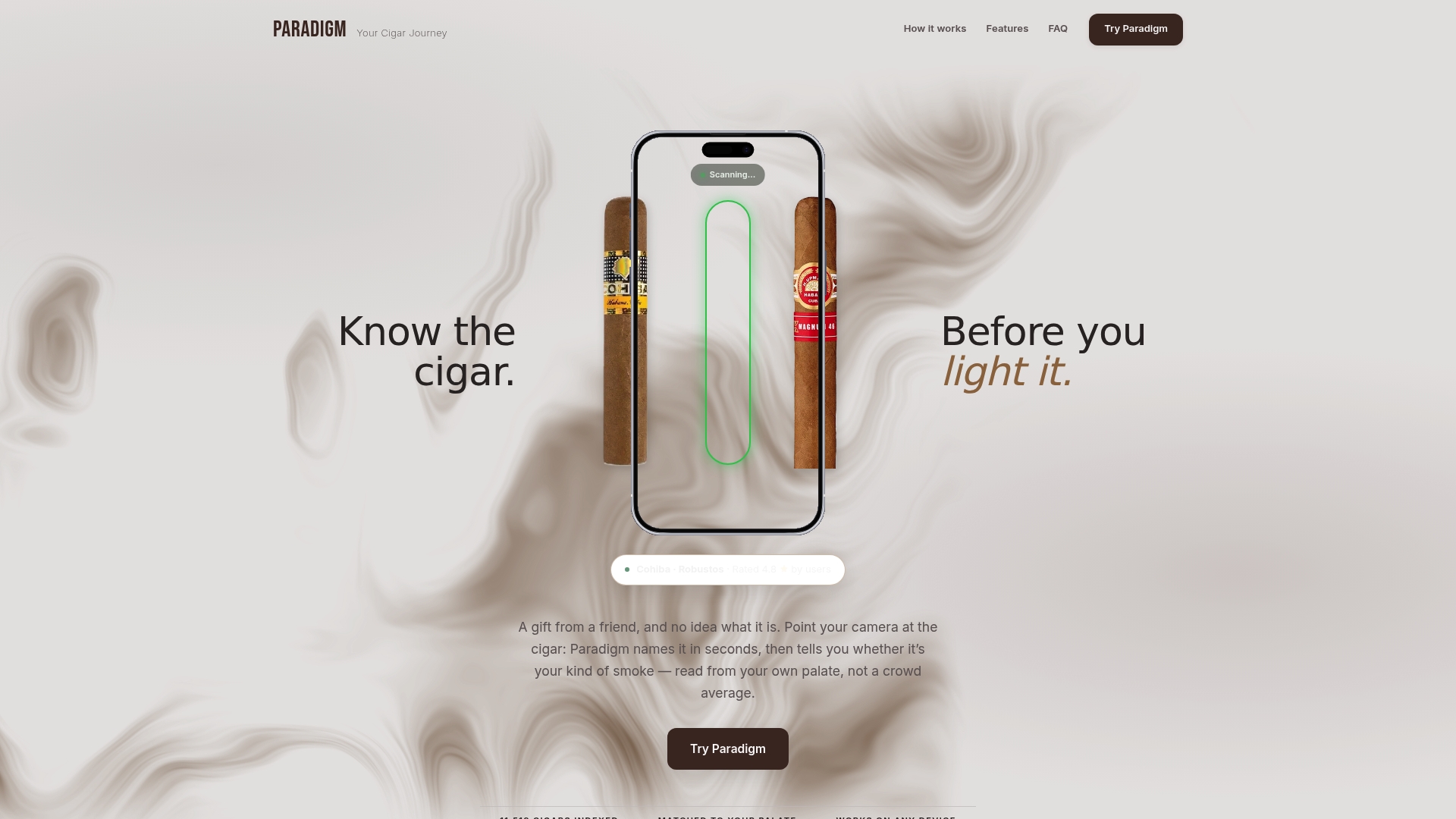
Paradigm runs as a browser-based progressive web app, so there is nothing to download, just add it to your home screen and it behaves like a native app. Scan the cigar — band, wrapper, shape, and cap — or search manually to identify cigars in its catalog. Each entry feeds a five-dimension palate profile that sharpens with every rating, following the same burn-in-then-adapt logic described above, and every recommendation comes with a Tasting Match explanation before you light up, not just a score after the fact.
| Step inside Paradigm | What it does for your profile |
|---|---|
| Scan or search a cigar band | Identifies the cigar and logs it to your history |
| Rate strength, body, and flavor | Feeds the five-dimension palate profile |
| Review the Tasting Match | Shows predicted fit before you smoke |
| Add private tasting notes | Builds a searchable, personal smoking history |
For more on the mechanics, our post on how AI cigar recommendation apps work and our breakdown of predicting whether you'll like a cigar go deeper into both the onboarding flow and the logic behind each Tasting Match. Start with a few scans and honest ratings this week, and your recommendations should already feel noticeably more specific to you.
Why a disciplined approach beats chasing lists
Most smokers trying to find their next favorite cigar default to scrolling top-ten lists, and most of those lists tell you nothing about your own palate. A short, honestly rated burn-in beats a long, vague review every time, because the system learns more from "medium body, more pepper than I expected" logged consistently than from a paragraph of praise written once and never repeated.
The same logic that helps a cold-start algorithm also helps you as a smoker: small, repeated, structured observations build a better long-term library than occasional long reviews. Try the burn-in routine over your next several smokes, then look back at your notes. You will likely notice your own patterns before the recommendations even catch up.
— Yaro
FAQ
What counts as a good burn-in set for personalized cigar recommendations?
A good burn-in set includes 3 to 7 cigars that differ in strength, body, and flavor family rather than cigars you already know you like. Cold-start research shows diverse, deliberately chosen items teach a recommendation system more per rating than a narrow or repetitive set.
How is an AI recommendation different from an expert's pick?
An expert recommendation reflects one palate and general consensus, while an app-driven recommendation adapts specifically to your own ratings and history. Over time, a personalized system can account for quirks an expert review would never capture, like your dislike of pepper-forward finishes regardless of overall quality.
Is my tasting data private when I use a cigar journal app?
Reputable cigar journal apps keep your ratings and notes in a private, searchable history tied to your account, not shared publicly unless you choose to post reviews. Always check an app's specific privacy terms before entering detailed personal preference data.
How much does a personalized cigar recommendation app cost?
Pricing varies by app and typically includes a free tier with paid upgrades for advanced features like full palate profiling or unlimited journal entries. Check the specific app's pricing page for current plan details before subscribing.
How soon will recommendations actually feel accurate?
Expect a noticeable improvement after 5 to 10 honestly rated cigars, once the system has enough data to move past broad, conservative guesses. Consistent rating habits speed this up more than smoking a large volume of cigars inconsistently.
Sources
- Cold-start Recommendation by Personalized Embedding Region Elicitation
- Certified Cigar Reviews™ | Tobacconist University
- Eliciting auxiliary information for cold-start user recommendation (survey)
Recommended
- Why does my cigar keep going out, burn unevenly, or taste bitter — and how do I fix it?
- What cigar etiquette mistakes do even experienced smokers still get wrong?
- How do I deliberately get better at telling cigars apart instead of everything tasting the same?
- How can I predict whether I'll like a cigar before I actually smoke it?