Collectors: 10 Fields That Make Humidor Inventory Tracking Work

For most collectors, a purpose-built humidor-tracking app that links inventory to humidor climate delivers the best accuracy and long-term value. Spreadsheets work fine for tinkerers who want custom fields, and paper still suits small collections kept for the ritual of it. But once you own more than a box or two across more than one humidor, searchability and climate data stop being nice extras and start being the difference between an organized collection and a guessing game.
TL;DR:
- A humidor-tracking app with climate support is essential once a collection exceeds 50 cigars or spans more than two humidors.
- Key data fields should include brand, size, quantity, location, purchase date, origin, price, tasting notes, and photos for comprehensive record-keeping.
- Monitoring humidity and temperature weekly with calibrated digital hygrometers helps prevent mold and beetle infestations, especially when logs track climate events.
- Organizers should count by tray, leave at least 10% to 15% of capacity empty, and assign sensors per zone for accurate climate management.
- An app with barcode scanning, photo attachments, backup options, and searchability ranks highest in usability and long-term value for cigar collectors.
Choosing a Humidor Inventory Tracking Method: App, Spreadsheet, or Paper?
Each method solves a different problem, and the right one depends on how many cigars you own and how much you enjoy fiddling with data.
Apps win on speed and connection. Scan a cigar's band, wrapper, and shape, log a purchase, check what's aging in a specific humidor, and back everything up automatically. Community threads on cigar forums consistently point collectors toward apps with humidor support precisely because manual entry gets tedious past a few dozen sticks. Dedicated platforms also build in features like barcode scanning and timeline journaling that spreadsheets can't replicate without serious setup work.
Spreadsheets win on flexibility. If you want a custom column for "gifted by," or you're importing 300 rows from an old paper ledger, nothing beats a spreadsheet's raw editability.
Paper wins on nothing measurable, but it has charm. A leather-bound log next to your humidor feels good to write in. It just falls apart the moment you need to search "every Nicaraguan puro I bought in 2023."
- Switch from paper to digital once your collection crosses roughly 50 sticks or two humidors.
- Switch from spreadsheet to app once you want climate data tied to specific boxes.
What to Record for Every Cigar in Your Collection
A tracker is only as useful as the fields behind it. Start minimal, then add depth as your habits mature.
- Brand and name — the baseline for any search or filter.
- Vitola and size — ring gauge and length affect aging speed and smoking time.
- Quantity on hand — updated every time you smoke or buy.
- Humidor location — which box, tray, or drawer it's sitting in.
- Purchase date — the anchor for every aging calculation you'll ever run.
- Wrapper, binder, and filler — useful when you're building a flavor-profile history.
- Origin and strength — Cuban vs. New World, mild to full, both matter for rotation planning.
- Price, seller, and lot or box code — critical if you ever trade, sell, or need to trace a bad box.
- Tasting notes, rating, and session date — the journaling layer that turns inventory into a real record.
- Photos — band shots and box codes help confirm authenticity later.
Retail catalogs show that size, wrapper, and strength are the standard fields the cigar trade itself uses to describe a stick, so mirroring that structure in your own tracker keeps your records consistent with what you'll see when buying or researching.
How Do You Monitor Humidor Climate and Know It's Stable?
Most premium cigars store best between 65% and 70% relative humidity at 65 to 70°F. Push past typical ideal humidity ranges for extended periods and you invite mold and tobacco beetle activity. Drop below typical ideal humidity levels and wrappers start to crack.
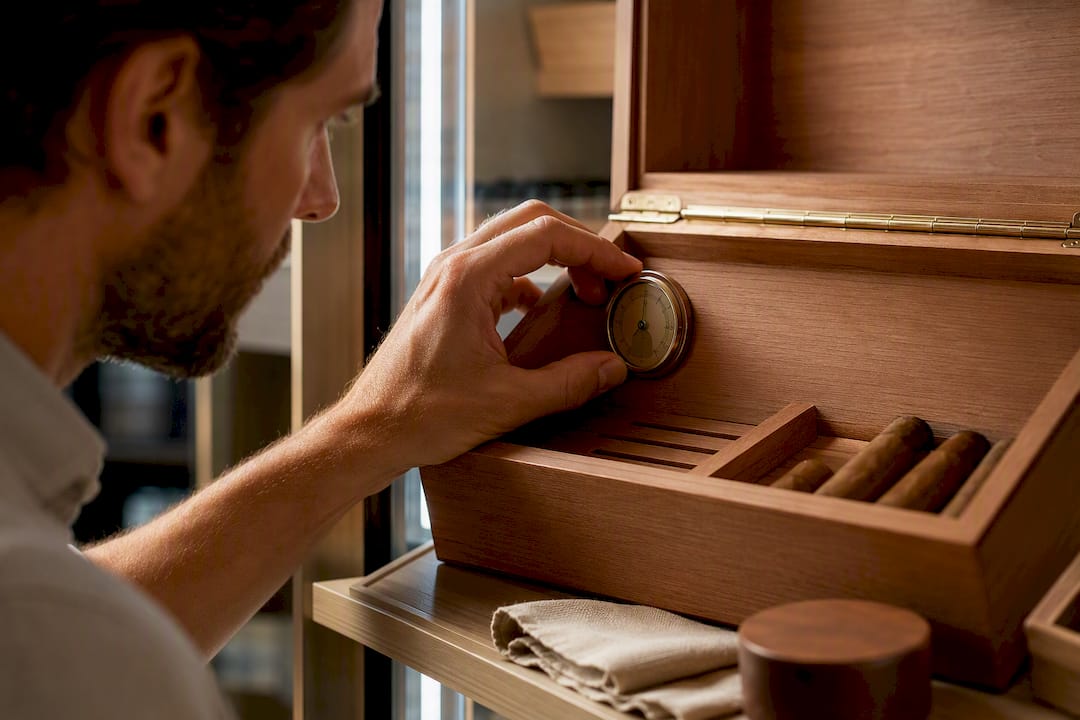
Digital hygrometers are worth the upgrade over analog dials, which drift badly and rarely self-correct. Calibrate any hygrometer with a simple salt test twice a year, and replace analog units that read more than 3% off after calibration.
You'll also hear collectors mention the "135 rule," shorthand for keeping temperature and humidity numbers that add up near 135 (like 70°F and 65% RH) as a rough balance point. Treat it as a mnemonic, not a law. Your specific cigars, climate, and humidor construction matter more than hitting an exact number.
- Check hygrometer readings weekly at minimum.
- Log any reading outside your target range as an event, not just a number.
- Replace humidity packs on a schedule rather than waiting for visible problems. Apps like Humi track pack age and flag maintenance windows with color-coded alerts, and similar logging tools track RH drift over time and send alerts when readings drift.
Pro Tip: Tie every humidity spike or drop to the specific batch stored at that time. If a box develops mold six months later, you'll have the exact climate event that caused it instead of a guess.
Organizing Multiple Humidors and Calculating Capacity
Capacity math is simpler than it looks. A standard 50-count humidor holds roughly 50 loose sticks, but boxed cigars take up more room, so a realistic working number is closer to 35 to 40 boxed cigars per 50-count unit once you leave circulation space.
- Count by tray, not by humidor. Measure how many sticks fit per tray, then multiply by tray count.
- Build a location hierarchy in your tracker: humidor name, then tray, then row or slot. Mapping the physical layout this precisely is the fastest way to find one specific stick in a large collection without opening five drawers.
- Leave 10 to 15% of capacity empty for air circulation and humidity media. Overpacked humidors hold humidity unevenly.
- Assign a sensor per zone if you run more than one humidor, and log readings against the batches stored in that zone specifically.
Managing a Cigar Wishlist and Smoking Rotation
A wish list should live next to your inventory, not inside it. Keep purchased cigars and "cigars I want" as separate lists that cross-reference each other, so buying something off your wish list moves it into inventory automatically rather than creating duplicate entries.
Retailers have already normalized this pattern. Several vendors built wish list features specifically for planning future purchases and sharing gift ideas, and similar wish list tools appear across most major cigar retailers.
For rotation, most collectors run two systems at once:
- FIFO for daily smokers — oldest stock gets smoked first to avoid over-aging cigars that don't benefit from long rest.
- Age-first tagging for cellar cigars — mark specific boxes "cellar" so your tracker excludes them from FIFO suggestions entirely.
- Log every trade, gift, and purchase with date and source, so provenance stays intact if you ever sell or need to verify authenticity.
A Quick Checklist for Evaluating a Humidor Tracker
Before committing to any tool, run it against these criteria.
Must-haves:
- Multi-humidor support with location fields
- Export or backup that gives you your full dataset, not a locked-in subset
- Photo attachments per cigar or box
- Search and filter by any field you actually use
Nice-to-haves:
- Whole-cigar scanning (band, wrapper, and shape) or photo-based identification
- Climate sensor integration tied to specific storage zones
- Analytics on aging timelines and collection value over time
Usability checks:
- Bulk edit for adding a whole box at once
- Import/export in common formats (CSV at minimum)
- Offline access for basements and cellars with weak signal
Community feedback on cigar forums consistently ranks searchability and photo attachments as the two most-used features after the basic inventory fields, ahead of flashier options like analytics dashboards.
How Paradigm Your Cigar Journey Applies These Standards
An app that recognizes a cigar's band, wrapper, shape, and cap against a large catalog can help avoid relying on manual entry when a band is worn or partially removed.
- Tasting notes and ratings can be logged to a private, searchable smoking history tied to each cigar.
- Palate profile guidance may adapt over time based on rated cigars rather than a static preference form.
- Catalog search can provide manual lookup when scanning fails, keeping identification reliable.
For readers comparing full app workflows against spreadsheet setups, this breakdown of tracking approaches covers the migration tradeoffs in more depth, and a dedicated guide to sensor integration covers what to look for if climate monitoring is your priority.
Why Consistent Data Beats Guesswork
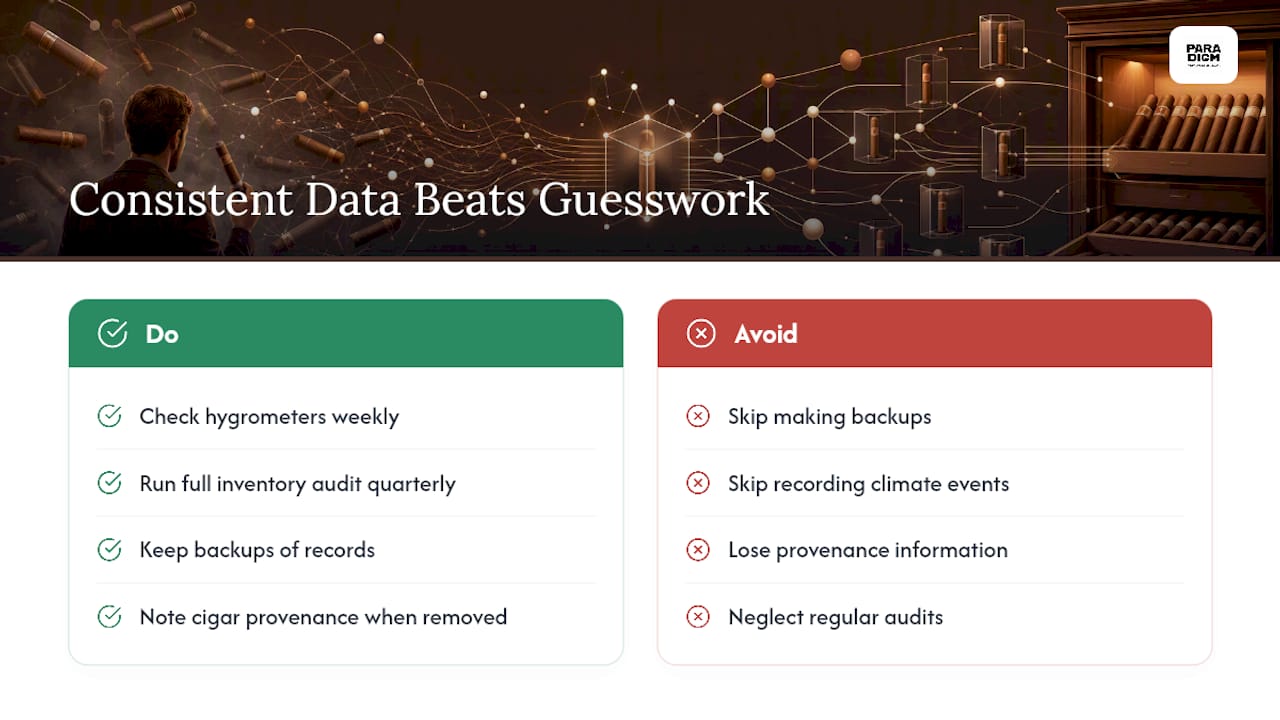
Collectors who check hygrometers weekly and run a full inventory audit quarterly catch problems early: a slow humidity drift, a box that's aged past its peak, a stick nobody remembers buying. The collectors who struggle share the same habits. No backups. No record of climate events. No note of where a cigar came from once it's out of the box.
None of this requires obsession. It requires a system you actually maintain.
— Yaro
Start Tracking Your Collection With Paradigm Your Cigar Journey
This type of app can provide the features this checklist demands, such as whole-cigar recognition (band, wrapper, and shape) replacing manual entry, tasting notes and ratings building a searchable smoking history automatically, and palate profiles that improve over time with usage.

Getting started takes minutes: create an account, add your first humidor, and either scan the cigar or search the catalog manually to log your first cigar. From there, every purchase, tasting note, and rating builds toward a record you can actually search instead of one you have to remember. Start your cigar journal and see how your first few entries look inside the app.
Sources
For readers comparing specific apps before committing to one, a few resources are worth a look:
FAQ
Is there a good app for tracking cigar inventory?
Yes. Several dedicated apps, including Paradigm Your Cigar Journey, offer whole-cigar recognition, multi-humidor support, and searchable tasting histories, which cover the core needs of most collectors better than a spreadsheet or paper log.
What is the 135 rule for cigars?
The "135 rule" is a rough mnemonic suggesting your humidity percentage and temperature in Fahrenheit should add up to around 135, such as 65% RH at 70°F. It's a starting reference point, not a strict standard, since specific cigars and humidor conditions vary.
Is 75% humidity too high for a humidor?
Yes, for most long-term storage. Most premium cigars do best between 65% and 70% RH. Sustained humidity above the typical ideal range increases the risk of mold and tobacco beetle activity.
How can I tell how many cigars my humidor holds?
A 50-count humidor realistically holds closer to 35 to 40 boxed cigars once you account for that buffer.