Test 12 Smokes to Find Cigars by Filler: Scans, Filters for Smokers

Yes, you can reliably find cigars by filler, and the fastest route is combining online catalog filters with a quick in-person construction check. Search for "long filler" or "handmade" in vendor descriptions, ask your tobacconist which primings dominate the blend, then confirm on the stick by checking the foot, the wrapper's condition, and the ring gauge before you buy.
TL;DR:
- Choosing long filler cigars generally results in a slower burn, more layered flavor, and a firmer ash compared to short filler options.
- Filtering online catalogs by "long filler" and assessing strength sliders can help identify cigars with the desired priming composition and potency.
- In-person checks of construction, filler visibility, and ring gauge size can verify filler quality and influence the smoking experience.
- Blends with ligero or Medio Tiempo content age better and develop more complexity over months or years, unlike milder, milder blends with less oil.
- Tracking personal tasting notes and preferences through an app refines your understanding of filler profiles, speeding up future selection.
What Is Cigar Filler, and Which Types Should You Search For?
Filler is the tobacco packed inside the binder and wrapper, and it does most of the work in determining a cigar's strength and how it changes from the first third to the last. A fine cigar usually contains between two and five different types of filler tobacco, and premium handmade cigars are typically built from long filler, meaning whole leaves rather than the chopped scraps used in short filler blends. That distinction alone should shape your search.
Long filler burns slower and produces layered, evolving flavor with a firmer ash. Short filler, common in machine-made and value-priced cigars, burns faster and tends toward a flatter, less-developed flavor. Mixed filler blends sit in between, combining long and short leaf to hit a price point while still offering some complexity.
Beyond leaf length, blenders classify filler by priming position on the tobacco plant, and knowing these terms turns you into a much sharper shopper:
- Volado — grown low on the plant, mild and combustible, mostly there for burn quality rather than flavor.
- Seco — mid-plant leaf with moderate strength and aromatic lift.
- Viso — upper-middle leaf, fuller-bodied and often the backbone of a balanced blend.
- Ligero — top-of-plant leaf, thick and oily, the primary driver of strength and pepper.
- Medio Tiempo — a rare leaf found on roughly one in ten plants, used sparingly as an intensity accent rather than a base component, according to Cigar & Cocktail Magazine's blending breakdown.
Blenders typically layer three to five of these primings, sometimes from different countries, to engineer how a cigar tastes in the first third versus the last. That's the real reason two cigars with similar wrappers can smoke nothing alike.
How Do You Actually Find Cigars by Filler?
Start online, then verify in person. Retailers rarely publish a leaf-by-leaf breakdown of their blends, but they leave enough clues in catalog metadata and product copy to narrow your search dramatically.
- Filter by long filler or handmade. Advanced search tools like Holt's cigar finder let you filter by wrapper, strength, and country of origin, and many catalogs flag "long filler" or "handmade" directly in the listing when full blending details aren't disclosed.
- Use the strength slider as a filler proxy. A "full" or "extra full" rating usually signals a ligero-forward or Medio Tiempo-accented blend; "mild to medium" usually points toward more volado and seco.
- Filter by country of origin, but don't stop there. A Nicaraguan puro tells you the filler is entirely Nicaraguan leaf, but a country filter alone doesn't tell you which primings dominate. Puro status is a stylistic choice by the blender, not a guarantee of a particular flavor intensity.
- Ask the tobacconist three direct questions: Is this long filler? Which priming positions dominate the blend? Is it a puro, or does the filler mix origins?
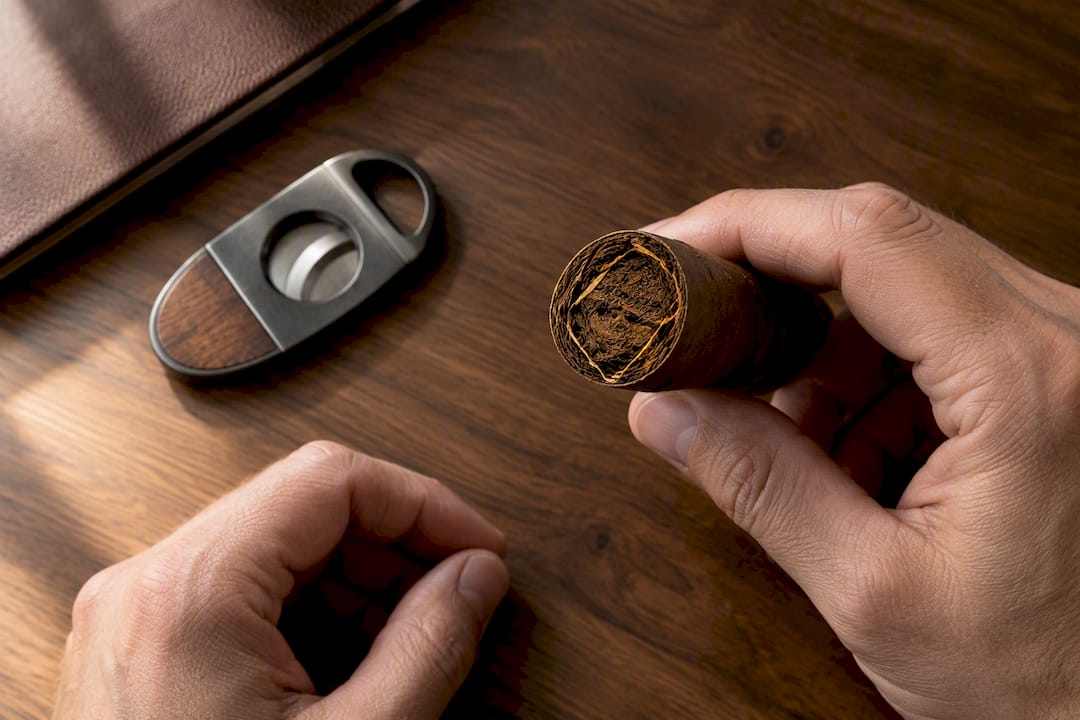
- Check construction in person before you commit. Squeeze gently along the length. It should have slight give with no hard spots or soft pockets. Look at the foot (the end you light) to see the filler leaves, and expect some visible veins. That's normal, since filler is selected for flavor and combustion properties rather than visual perfection.
- Note the ring gauge. A larger ring gauge shifts more of the smoking experience toward the filler; a thinner one puts more weight on the wrapper.
Pro Tip: Save your notes every time you buy. If a "full-bodied Nicaraguan" leaves you cold but a "medium Honduran with visible ligero" hits the mark, you've just identified a pattern worth chasing on your next purchase.
A discovery app can compress this whole workflow. Scan the cigar — band, wrapper, and shape together — to pull up its profile, search catalog fields when scanning fails, log your reaction, and let a personalized match score point you toward the next candidate. Search, confirm on the stick, log the result, refine your next search. That loop is where most people's filler preferences actually sharpen.
What Should You Expect From Different Filler Blends?
Filler composition sets the ceiling on strength and shapes how a cigar unfolds, and format decides how much of that filler character actually reaches your palate.
- Mild and creamy blends lean on volado and seco leaf, letting wrapper sweetness lead while the filler stays quietly supportive. These are the easiest starting point for a beginner.
- Balanced, viso-forward blends carry more body and tend to shift noticeably across the three thirds, opening mellow and building toward a fuller finish.
- Full-bodied, ligero- or Medio Tiempo-forward blends deliver pepper, char, and density from the first third onward, and they're unforgiving of a rushed draw.
Ring gauge changes how much of that filler personality you actually taste. A thinner vitola like a lancero concentrates wrapper flavor because there's proportionally less filler packed inside, while a fatter robusto or toro gives the filler blend more room to dominate the smoke. Cigar Country's format guidance notes that robusto and toro shapes are more forgiving for showing off a filler blend, while lanceros put wrapper character front and center; a wrapper can account for a meaningful share of what you taste, and that share shrinks as ring gauge grows.
Wrapper leaf gets judged on looks. Filler leaf gets judged on burn rate, flavor, and strength, and a few visible veins in the filler are a sign of function, not a defect.
How Paradigm Your Cigar Journey Helps You Find Cigars by Filler
Matching a filler profile to your palate usually takes several purchases and a decent memory for what you smoked last month. Trial-and-error can be turned into something trackable by using a cigar journal app.
Scan the cigar — band, wrapper, shape, and cap together — to pull it from a catalog of cigars; if scanning fails, search the catalog manually by name or brand. Set your preferred strength and flavor profile once, and the app's Tasting Match tells you whether a specific cigar is likely to suit you, with an explanation you can weigh against the tobacconist's answers. After you smoke it, log tasting notes and a rating, and your palate profile sharpens with every entry, making the next filler-based search faster than the last.
Dominican, Nicaraguan, and Honduran Filler: What Sets Each Apart
Country of origin shapes filler character, though skilled blending across primings usually matters more than a single country label. Still, regional tendencies are real enough to guide a search.
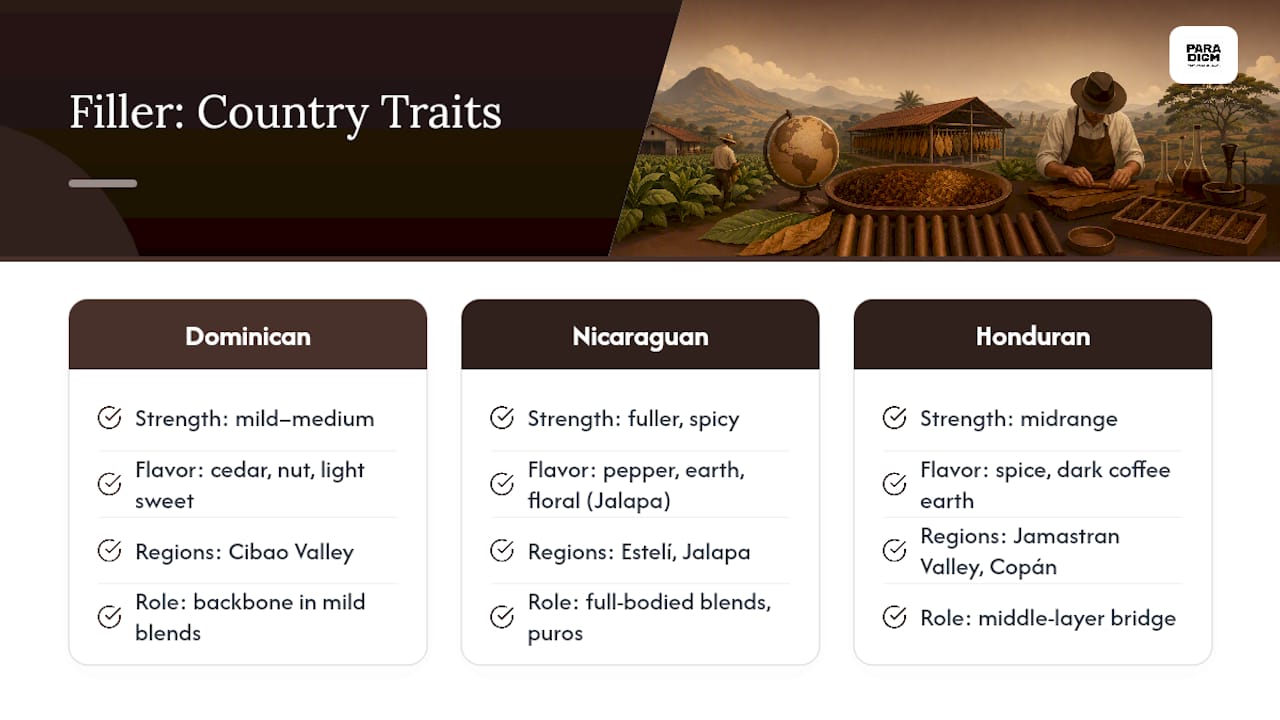
Dominican filler tends toward the gentler end of the spectrum, especially leaf grown in the Cibao Valley. Expect cedar, nut, and a light sweetness, with strength that rarely goes past medium unless the blender leans hard on ligero. It's a common backbone for mild and balanced blends, and one reason so many beginner-friendly cigars carry Dominican filler somewhere in the mix.
Nicaraguan filler, particularly from Estelí and Jalapa, runs fuller and spicier. Jalapa leaf brings more sweetness and floral notes, while Estelí leaf tends toward pepper, earth, and a heavier body. Nicaraguan puros and Nicaraguan-heavy blends dominate the full-bodied end of most catalogs.
Honduran filler, grown mainly in the Jamastran Valley and Copán, often lands between the two. It carries a distinct spice and dark, coffee-like earthiness, with less of the raw ligero punch you get from Nicaragua but more depth than a typical Dominican leaf. Blenders frequently use Honduran leaf as a middle layer, bridging a mild wrapper and a fuller ligero core.
Because puro status alone doesn't determine strength, checking which primings a blend uses matters more than checking a flag on a country of origin filter.
Matching Filler Type to Your Palate and the Occasion
Pick filler strength the way you'd pick a drink for the moment, not just for the label on the box. A weeknight smoke after dinner calls for something different than a two-hour backyard session with friends.
For a first cigar or a casual thirty-minute break, reach for a mild, volado and seco-heavy blend in a robusto or toro. It's forgiving on the draw and won't leave you nauseated if you inhale a little smoke by accident, which happens to nearly everyone starting out.
For an evening where you actually want to taste the cigar evolve, a viso-forward balanced blend rewards patience. These are the cigars worth smoking slowly, since the shift from the first third to the last is the whole point.
Full-bodied, ligero-heavy or Medio Tiempo-accented cigars belong at the end of a big meal, alongside a dark spirit, or in any setting where you have real time and an empty stomach isn't a concern. These blends punish rushing and reward smokers who've built up a tolerance over dozens of cigars. If you're still building your palate, this guide to widening your palate systematically is worth a read before jumping straight to the strongest box on the shelf.
Match the occasion to the filler intensity first, then let wrapper and origin fine-tune the choice.
Which Cigar Lines Are Known for Specific Filler Styles?
You don't need a blending degree to shop by filler reputation. Certain lines have built their identity around a specific filler approach, and that reputation is a shortcut when a catalog listing doesn't spell out the blend.
Mild, Dominican-filler-forward lines tend to market themselves around smoothness and easy draws, often pairing a Connecticut-style wrapper with seco and volado dominant filler. Balanced, Nicaraguan-Honduran blends show up constantly in mid-tier price brackets, using viso as the backbone with smaller amounts of ligero for lift. Full-bodied lines built around heavy ligero content, and the rarer Medio Tiempo-accented releases, tend to sit at the premium end of a shop's full-bodied section and usually carry strength ratings of "full" or "extra full" right on the band or box.
When a line's marketing leans on words like "smooth," "mellow," or "creamy," expect filler weighted toward volado and seco. When the marketing leans on "bold," "spicy," or "maduro-paired," expect ligero doing most of the work. Reading between the lines of a brand's own positioning is often faster than hunting for a technical spec sheet that doesn't exist.
Why Filler Choice Affects How a Cigar Ages in Storage
Filler composition determines how much a cigar changes in the humidor, not just how it smokes fresh off the shelf. Ligero-heavy and Medio Tiempo-accented blends carry more oil and stronger compounds, and that density gives them more room to mellow over months or years of proper storage at 65 to 70% relative humidity.
Milder, volado and seco-forward blends have less raw material to transform. They peak sooner and offer a shorter window where aging meaningfully improves the smoke, since there's simply less concentrated leaf undergoing the slow fermentation that happens in a humidor.
Long filler cigars also age more predictably than short filler ones. Whole leaves retain oils and moisture more evenly, which is part of why long filler produces a firmer ash and steadier burn even after years in storage. Short filler blends, built from chopped leaf fragments, dry out unevenly and rarely reward long-term aging the way a full-leaf ligero blend does.
If you're buying with aging in mind, prioritize long filler cigars with a heavier ligero or Medio Tiempo component, and expect the payoff to take longer than it would with a milder blend built for smoking now rather than later.
Treat Your First Dozen Cigars as an Experiment, Not a Verdict
Your first few cigars won't tell you much on their own. Sample deliberately across wrapper shades and filler intensities, and let the pattern emerge over ten or twelve smokes rather than three. Save notes on what you actually liked, not what you expected to like, and let that data pull you gradually toward ligero and Medio Tiempo territory as your tolerance builds.
— Yaro
Ready to Track Your Own Filler Discoveries?
Reading about primings and ring gauges only gets you so far. The real learning happens after you finish a cigar, when the flavor is still fresh enough to describe accurately. Paradigm Your Cigar Journey lets you scan the cigar — band, wrapper, shape, and dimensions together — check your personalized Tasting Match before you even light up, and log what actually happened in your mouth once you're done. Over time, that record becomes the fastest filter you own, sharper than any catalog dropdown, because it's built entirely from your own smoking history.
Sources
- The Filler: The Heart of the Cigar — Cigar & Cocktail Magazine
- Filler | Cigar Aficionado glossary
- Long filler vs short filler cigars | Cigar Grail
- Holt's advanced search / cigar finder
- What is Cigar Filler? | JR Cigars Blending Room
FAQ
What's the fastest way to find cigars by filler online?
Filter by "long filler" or "handmade" in the catalog, then use the strength slider as a rough proxy for priming composition. Retailer search tools that let you filter by wrapper, strength, and country narrow the field quickly before you ever talk to a tobacconist.
What's the difference between long filler and short filler?
Long filler uses whole tobacco leaves and produces slower, layered flavor with a firmer ash. Short filler uses chopped leaf pieces and burns faster with a less-defined flavor arc, which is why nearly all premium handmade cigars use long filler.
What is Medio Tiempo, and why is it rare?
Medio Tiempo is a top-of-plant leaf that appears on roughly one in ten tobacco plants, used sparingly as an intensity accent rather than a main filler component. Its rarity is why it usually shows up only in full-bodied, premium-priced blends.
Does a puro guarantee a specific filler strength?
No. Puro status means the filler comes entirely from one country, but the actual strength depends on which priming positions the blender chose, so a puro can still land anywhere from mild to full depending on how it's built.
Can an app help me find cigars by filler type?
Yes. Paradigm Your Cigar Journey lets you scan a cigar's band, wrapper, and shape against a catalog of Cuban and New World cigars, then uses your saved preferences to generate a Tasting Match before you smoke, helping you narrow candidates without guessing blind.