Decode Cuban Box Codes: Timeline, Checklist, Track in Paradigm
Every real Cuban box carries two ink stamps on the underside: a factory code that identifies where the cigars were rolled, and a boxing date that tells you when they went into the box. Since around 2000, that date has been stamped as a three-letter Spanish month abbreviation plus a two-digit year, so a box marked OCT 01 was sealed in October 2001. Read the date first, then treat the factory code as one clue among several, because those codes shift over time and can't authenticate a box on their own.
TL;DR:
- Boxes stamped after 2000 display a three-letter Spanish month abbreviation and a two-digit year, making recent dating straightforward.
- Factory codes are assigned periodically and can be misleading, so they should only supplement verification, not be used alone to determine origin.
- A counterfeit or misdated box can have accurate stamps but fail authentication checks like seal, hologram, barcode, or packaging quality.
- The boxing date provides a close estimate of harvest time, guiding aging strategies and provenance verification, especially for high-value or limited editions.
- Tracking apps help record boxing dates and tasting notes, enabling better long-term management of cigar inventories beyond simple visual inspection.
Cuban Box Codes: Finding the Factory Code and Boxing Date
The two stamps sit close together, but they answer different questions. The factory code is a short internal identifier, usually two to four letters, that Habanos uses to track which factory rolled the cigars inside. The boxing date is a separate stamp, almost always showing the month and year the box was sealed, not the date the tobacco was harvested or rolled.
Where to look depends on the packaging:
- Wooden boxes: check the bottom panel, where both stamps are usually inked in black or blue near the center or a corner.
- Outer cardboard sleeves or cartons: look for a matching or corresponding stamp on the carton itself, since some retailers separate boxes from their original sleeves.
- Cedar liners: genuine boxes typically include a thin cedar sheet lining the interior, a small but telling detail if it's missing entirely.
- Habanos hot-stamps: phrases like "Habanos s.a." or "Hecho en Cuba" are heat-pressed into the wood, distinct from the ink-stamped codes and dates.
Get comfortable spotting all of these together before you try to date a box from memory.
A Short History of Cuban Box Codes, From 1985 to Now
Reading a Cuban box code correctly depends on knowing which era produced it, because Habanos has changed its dating system more than once.
- 1985 to 1998, the NIVEL/ACUSO system. Habanos deliberately obscured the boxing date using a letter-to-number mapping scheme known as NIVEL/ACUSO, where specific letters substituted for digits. A collector holding a box from this window can't simply read the stamp at face value. It has to be run through the mapping key, which is why so many older boxes get misdated by casual buyers.
- 1999, the transitional year. Different factories adopted different interim schemes, so boxes from this single year are notoriously inconsistent. Some carry partial NIVEL/ACUSO holdovers, others show early versions of the simplified format that would follow.
- 2000 to present, the simplified system. Habanos moved to the straightforward three-letter month plus two-digit year format still used today, a change Habanos itself documents in its official packaging guidance. Factory codes kept shifting even after this simplification, just less dramatically.
Why obscure the date at all in the first place? Part of it was internal quality control, letting the company trace production batches without broadcasting factory identity to the public. Part of it, according to Cigar Aficionado's own glossary, was managing consumer demand, since smokers who developed a preference for one factory's rolling style would seek out boxes from that source specifically. A disguised code kept that kind of factory-chasing in check.
Reading a Modern Box Date: Month Codes and Year Rules
Every post-2000 box follows the same pattern: a three-letter Spanish month abbreviation, a space, then the last two digits of the year. AGO 19 means August of a recent year in the 21st century. FEB 22 means February of a recent year in the 21st century. Once you know the twelve abbreviations, you can read almost any modern stamp on sight.
| Month | Abbreviation |
|---|---|
| January | ENE |
| February | FEB |
| March | MAR |
| April | ABR |
| May | MAY |
| June | JUN |
| July | JUL |
| August | AGO |
| September | SEP |
| October | OCT |
| November | NOV |
| December | DIC |
The two-digit year rarely causes confusion for boxes made after 2000, since nobody's mistaking a 22 for 1922. Older boxes are a different story: a stamp reading 98 could theoretically mean 1998 or, decades from now, 2098, so century context matters most for pre-2000 stock running through the NIVEL/ACUSO or transitional systems.
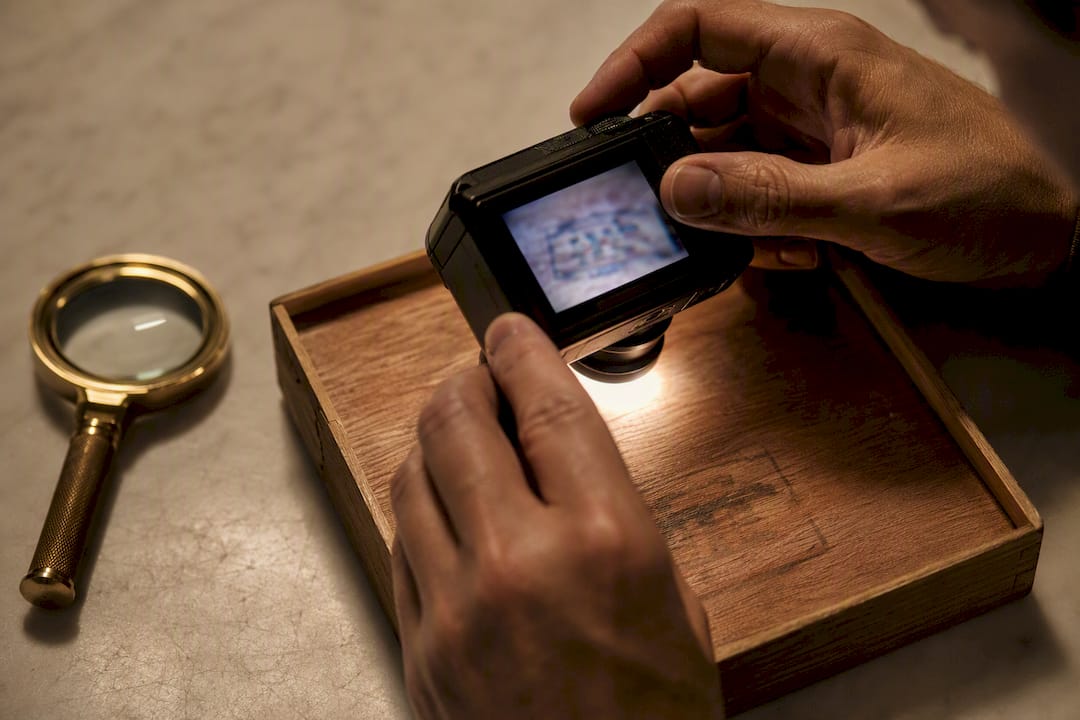
Pro Tip: Photograph the stamp straight on with a flash and zoom in afterward. Ink stamps on cedar smudge easily, and what looks like an "8" in dim light sometimes turns out to be a "3" or a "6" once you blow up the image.
Why Factory Codes Can Mislead Collectors
Factory codes tell you which production site rolled a box, but they're a moving target. Habanos reassigns and regroups them periodically, and the same two or three letters can point to a different factory five years later than they did when the box left the warehouse. That instability is exactly why community-built lookup tables age out fast, a pattern Holt's Clubhouse notes explicitly when explaining why older code charts often mismatch current production.
A few things worth keeping in mind:
- Codes have been rotated and reassigned more than once, so a chart from 2015 may not apply to a box made in 2024.
- Some codes represent groups of factories rather than a single physical location, muddying any claim of "this exact factory made this exact box."
- Relying on a factory code alone to assert precise origin is genuinely risky, since the letters simply weren't designed to serve as a permanent, unchanging registry.
Treat the factory code as one data point inside a broader checklist, never as proof by itself.
The Full Authentication Checklist Beyond the Date Stamp
A correct date stamp doesn't prove a box is real. Counterfeiters copy stamps convincingly, which is why Holt's Clubhouse advises checking the Habanos seal, hologram, and serial barcode as a separate step from reading the code.
- Verify the Habanos seal and hologram against the official packaging guidance, which describes the current authenticity features tied to serial tracking.
- Look for heat-stamped marks reading "Hecho en Cuba," "Habanos s.a.," and, on handmade lines, "Totalmente a Mano."
- Watch for mismatched fonts, inconsistent band artwork, or a stamp that looks freshly applied compared to a weathered box.
- A barcode confirms manufacturer identity through standard GTIN/GS1 data, but it rarely encodes a production date, so don't expect a barcode scan to substitute for reading the ink stamp itself.
- Poor cork or cedar quality inside a box claiming premium status is a reliable red flag on its own.
Reputable retailers, including specialty sellers like Thor's Cigar Vault, typically photograph these packaging details for exactly this reason.
Using Boxing Dates for Aging and Provenance
A boxing date isn't a harvest date, but it gets you close. Tobacco typically spends 18 to 24 months moving from harvest through fermentation and rolling before it reaches the box, so a stamp reading MAR 20 points to leaf harvested somewhere around late 2017 or 2018.
That window matters for a few practical reasons:
- It lets you plan cellar timelines instead of guessing when a box might be hitting its stride.
- Matching tasting notes to specific boxing dates helps you correlate flavor development with actual time in wrapper and time in your humidor, not just a vague sense of "this one seemed older."
- Documented boxing dates strengthen provenance for resale, since buyers of higher-value boxes want more than a seller's word.
Logging dates consistently, alongside how storage conditions affect long-term aging, turns a pile of scattered memories into something you can actually act on later.
Turning Box Codes Into a Tracking Habit
Reading a stamp once doesn't help you six months later when you can't remember which box tasted like leather and which tasted like cedar. A cigar tracking app can recognize a cigar from its band, wrapper, shape, and cap alongside boxing dates and tasting notes, building a searchable smoking history instead of a drawer full of loose photos.
- Scan the cigar — band, wrapper, shape, and cap — to identify it in the catalog.
- Record the boxing date from the stamp you just decoded.
- Add a tasting note tied to that specific box.
- Tag it for cellaring if you're holding it for further aging.
When the Exact Month or Factory Actually Matters
Precise boxing dates and factory identity carry real weight for limited-production runs, boxes tied to a specific known harvest, or high-value lots where provenance affects resale price. For an everyday box you're smoking within a year, chasing the exact factory letter is mostly trivia. Storage conditions and how the cigar actually tastes tell you more than the stamp ever will. Use the code as a starting point, not a fixation, and let your own tasting records carry more weight than a factory letter ever should.
— Yaro
Track Your Own Box Dates Without the Spreadsheet
Once you've decoded a stamp, the harder problem is remembering it later, especially once you're comparing five or six boxes across different vintages. Some cigar tracking apps give you a place to save a scan of the cigar's band, wrapper, and shape, log boxing dates, and attach tasting notes before details blur together. They don't authenticate cigars or replace seal and barcode checks. These apps simply keep what you already know organized in one searchable place instead of scattered across photos and notebooks.

If you're the type who wants more guidance on what a good tracking app should actually do before committing to one, that's worth a look too. Otherwise, open Paradigm and scan your next cigar before you forget which box it came from.
Primary Sources and Decoding References
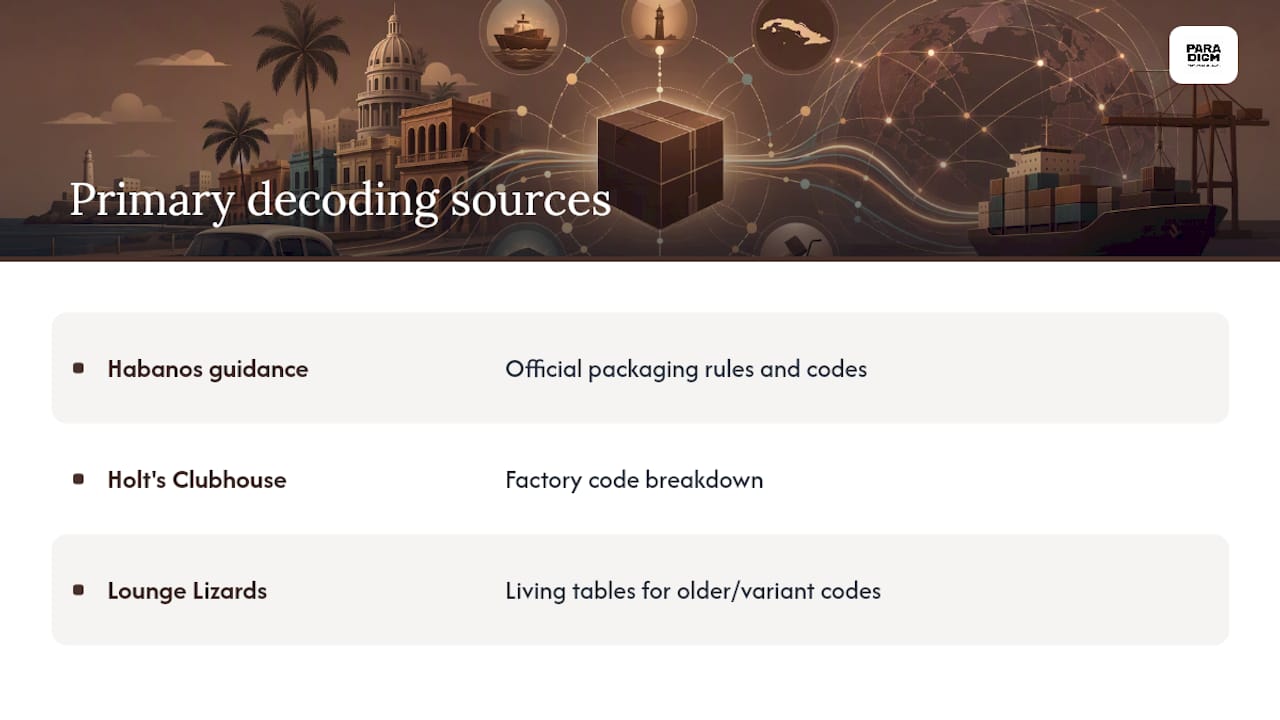
For deeper verification, consult Habanos' official packaging guidance, Holt's Clubhouse factory code breakdown, and the Lounge Lizards living code tables for older or variant codes.
Sources
- Cuban Cigar Factory Codes — Holt's Clubhouse
- Origen denomination – Habanos, S.A. – Official site
- Cuban Factory Codes - Lounge Lizards Podcast
FAQ
What Are the Factory Codes for Cuban Cigars?
Factory codes are short internal identifiers, typically two to four letters, that Habanos stamps on box bottoms to track which factory rolled the cigars. They're reassigned periodically, so older lookup lists frequently don't match current production.
How Do You Tell How Old a Cigar Box Is?
Check the ink stamp on the box bottom: since 2000, it reads as a three-letter Spanish month abbreviation plus a two-digit year, like OCT 01 for October 2001. Boxes made from 1985 to 1998 used the disguised NIVEL/ACUSO system, which requires a separate decoding key rather than a direct reading.
How Much Is a Box of Cuban Cigars?
Pricing varies widely by vitola, retailer, and market, so there's no single reliable figure to quote across regions and vendors.
Can I Bring Cuban Cigars Into the US in 2026?
Import rules for Cuban products change based on US policy and traveler status, so check current federal guidance directly before purchasing with the intent to bring cigars home.
Where Should I Look for the Boxing Date Stamp?
Check the bottom panel of a wooden box, near the factory code or the "Hecho en Cuba" hot-stamp, and cross-check any matching stamp on the outer carton if the box was separated from its original sleeve.
Can Paradigm Help Me Track Boxing Dates?
Yes. Paradigm Your Cigar Journey lets you scan a cigar's band, wrapper, and shape, log the boxing date from the stamp, attach tasting notes, and build a searchable smoking history, though it doesn't perform authentication itself.